

Canary in a Coal Mine
Deflationary pressures to persist
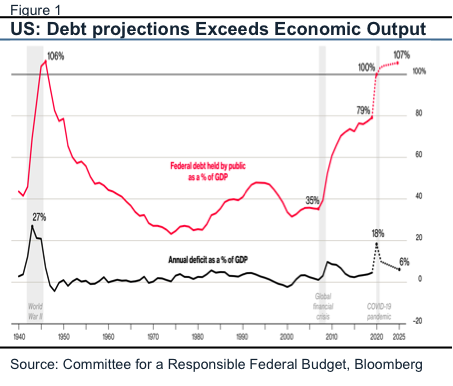
2020 has been the recipient of many firsts. Thus far, oil prices going negative, a global lockdown, a potential depression like no other, record US unemployment at 20.6% and counting, USD1.4 trillion purchases of financial assets in March by the G7 (5X that of April 09, and more to come), the Feb buying high yield debt, ‘Dr.’ Donald giving medical advice and it is only April. With unprecedented amounts of money printing further aggravated by the dispositions of algos and derivatives in an uncertain macro environment, we are willing to take that bet that we have not seen the end to the ‘many firsts’.
 | 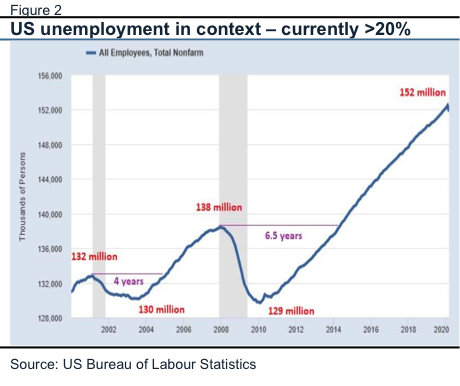 |
Warning signs are aplenty and if the market chooses to forget about these highly probable incidences of corporate defaults, long lasting unemployment and its ensuing ramifications to the macro landscape, the very least that it should assume (and it appears to be discounted) is the tenacity of the Covid-19 virus leading to a second wave or a near term resurgence should governments pander to the popular view of getting back to normal life. If this hypothesis of persisting infections in the near to medium term is to be held true, the start stop impact to the economy would likely result in lasting poor aggregate demand, at the very least. IMF is expecting global GDP growth of -3% in 2020 and a 2021 growth of +5.8% with the colossal caveat that the virus fades in 2H2020 and that policy actions taken around the world are effective in preventing widespread firm bankruptcies, extended job losses, and system-wide financial strain. Quite a caveat indeed.
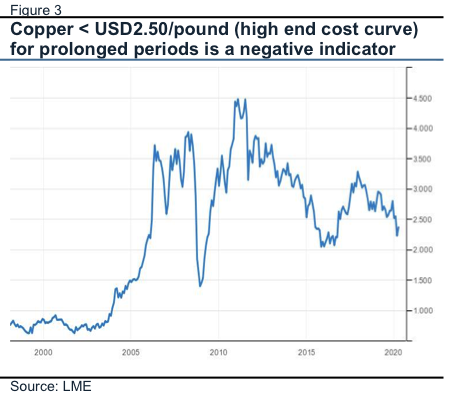
If a sustained weak global aggregate demand is the base case, we then arrive at the subject of deflation, further complicating the prospects of a quick economic recovery. While the very mention of the word deflation triggers prickly quivers amongst governments, it is hard to imagine not pondering it given depressed commodity prices, an amputated labour market, consumer fears leading to precautionary savings and of course a collectively lower disposable income given high sustained unemployment. Equally, companies with planned investments would likely reassess them, as will consumers with planned purchases. This tricky situation hardly acts as a spur to aggregate demand particularly as consumers weigh the possibility of prices getting cheaper before purchasing. For those who think these are merely economic conjectures, lo and behold, it is already happening with US Consumer Price Index for All Urban Consumers (93% of population) at -0.4% in March on a seasonally adjusted basis, the largest monthly decline since January 2015. Similar trends are seen across the Euro zone with abysmal PMI data being met by equally worrying March CPI of a mere 0.7%, down from the low 1.2% in Feb. It is worth remembering that the global lockdown outside of China started mid March onwards and juxtapose that with current offers for discounted hotel rooms, electronics, white goods, flight tickets, clothing brands, F&B etc, one would conclude that a negative vector for the 1.2% CPI data seen for the G7 in March 2020, is more likely than not. At this point, the best case we can prudently foresee is an extended period of low inflation. Whether it heads below zero will depend on developments on the virus front and the effectiveness of government/central bank policies, which at this point appear capricious.
 |  |
Under such circumstances of poor aggregate demand, the traditional policy response has been lower monetary policy and higher fiscal spending. Only now, in the developed world, this is highly prohibitive with near zero / negative interest rate environments, fiscal deficits at record highs and public debt to GDP on the extreme side (average G7 public debt to GDP in 2018 was 116% of GDP and now likely greater). The financial market structure in the US is not capable of handling a negative rate environment (think the far reach of Treasury bills) and the very suggestion of it is a scary outcome to ponder. Notwithstanding the unprecedented flood of liquidity in the system buoying price expectations off the deflationary mark as it has traditionally, we are of the view that the crisis we are facing today involves confidence of consumers and businesses alongside a delicate economic (and health) environment. To assume inflation under this backdrop seems to ignore the current tragedy at hand.
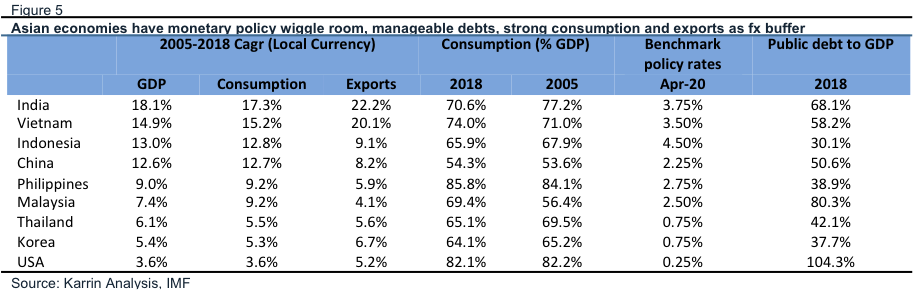
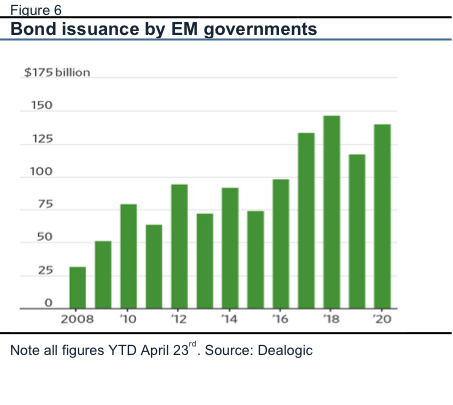
While uncertainties surrounding a rebound from the doldrums remain, coming out of the down cycle, our focus markets in Asia seem better positioned. For one, the Covid-19 virus appears relatively more contained (and well managed) and further ahead in terms of recovery (notable exceptions) and two, that orthodox monetary policy, contained debt levels, current accounts buffers and vast economic growth potential (projected to deliver >2/3 of global growth), all provide well needed buffers for investors looking into Asia. The recent USD4.3bil bond raised in the international markets by the Indonesian government (10.5 yr @ 3.9%, 30.5 yr @ 4.25% and 50 yr @ 4.5%) despite its twin deficit position, is further support of this thesis.
Notwithstanding growth potentials, the vulnerability of forex needs addressing given Asia’s vast dependence on the developed world for its exports and debt financing in the past. Learning from its former failures, Asia’s economic make up is notably different today where we see a transformation of its GDP to domestic consumption (deteriorations in Thailand) while also maintaining good buffers from growing exports and domestic denominated debt to ensure its currencies have the required balance and protection from external shocks. With the exception of India, Indonesia and Philippines, other Asian economies have been rolling out current account surplus positions, thought this year should see Covid-19 related deteriorations across the board.
 |  |
Private markets illustrate the true picture.
If the public markets paint a worryingly bullish picture, the M&A and private markets space produce a more realistic assessment of the crisis, where the strong 2020 start has reversed mid 1Q to a dearth of new M&As and widespread termination of deals. Asia Pacific (ex Japan) alone has seen deal values take a stark 32% YoY drop in 1Q2020 to USD103bn across 616 deals, the lowest quarterly value since 1Q2013 according to Mergermarket. More drastic is the buyout space where deals made by PE funds in 1Q2020 fell 54% YoY in value (USD 9.4bn, 74 deals), while exits by PE funds generated a mere USD4.8bn across 27 deals, down 72% in value.
 |  |
As we see many bidders delaying or terminating previously announced deals, it is increasingly evident that market volatility had severely impacted investors’ confidence to make significant strategic moves. We foresee this trend to persist as bidders buy time to assess the pandemic and its impact to businesses. This will certainly result in renegotiations of terms and pricing and worse a termination given the ability to invoke the Material Adverse Clause (“MAC”) with underlying business damages from the Covid-19 as justification (or excuse).
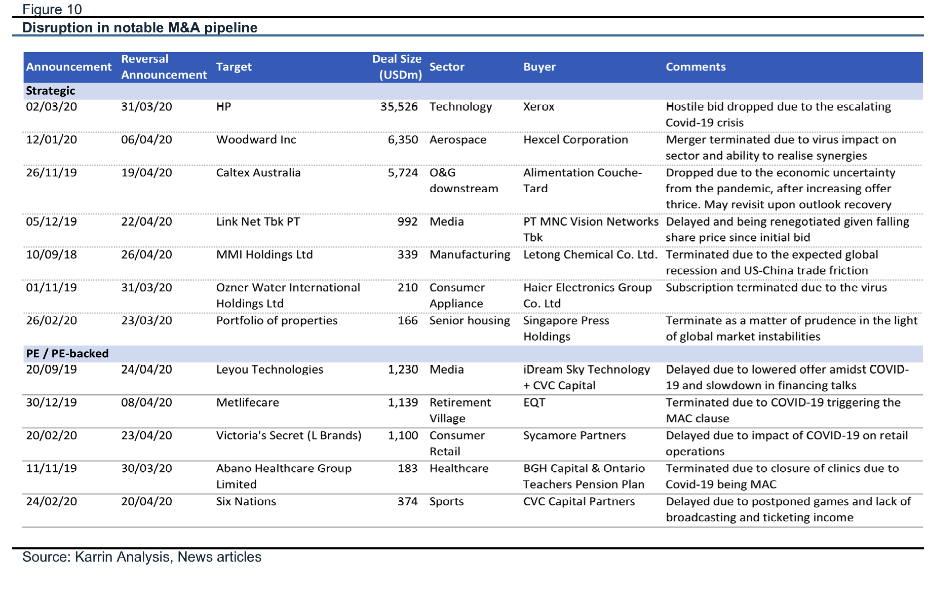
To assume a rapid recovery in the deal space is too optimistic given the absence of business normalcy which has curtailed travel, trade and activity even in nations past their virus peaks. As general demand destruction is far worse than what we have seen in the past, the leveraged loan market may remain closed for longer resulting in corporate and PE investors having to take a step back to scrutinise investment thesis deeper, extend due diligence windows to better understand the impact the virus, reassess underlying assumptions, and even re-examine the ability to exit within usual time horizons. From our findings, many sellers have equally postponed or pulled back sale processes as meetings, due diligence and negotiations have not been conducive.
While the backdrop of the PE scene appears tentative, investors should also be aware of the notable “dry powder” which according to Preqin at the leveraged buyout area alone stands at USD1.5 trillion (end 2019), of which >USD400bn sits in Asia-Pacific focused funds. As these ‘dry powder’ figures could likely have crept lower since the Covid-19, fund managers could be induced to call on these capital for the 2% management fees despite the uncertain outlook. Less cynically, is the fact that crises breed opportunity, and this essentially captures our very inception at Karrin Associates.
Looking through our lists, we foresee opportunities in sectors / companies, which portray stability or growth in this period of uncertainty. These gems will likely involve most things digital, certain healthcare services/products, education, and logistics; where given resilience we would expect premium valuations. Along with that, we seek good quality companies needing some capital to tide through market dislocations and companies which succeed in building resilient businesses around the changing macro landscape, demographics and human behaviour.
A framework for assessing company operations post Covid-19
The economic crisis will bring about opportunities as it will agony. Companies need a strategy in rethinking business models and repositioning to ensure value creation (or avoid destruction) coming out of this crisis. Apart from vigorous financial analysis and due diligence, the Karrin team has built an operating framework to ensure we avoid investments with existential pressures while ensuring that we spot opportunities to be had in this chaos. This framework should be applied as a general tool and with full understanding of individual idiosyncrasies.
1. Team management framework. It is now that management has to think outside the box to rejig the workplace for business continuity. These typically involve the application of technology, but more importantly, the right structures in place to ensure effectiveness in management and execution.
- Management of workflow – responsibilities, reporting lines and crosschecks to ensure workflow ownership.
- Problem solving framework / taskforce capable of preventing, assessing and solving issues.
- Contingency plans – ensure sufficient continuity in the event team members fall sick. Risk management is key.
- Staff retention – Morale and team spirit are paramount in times of crisis. Ensure management exercises empathy and implements thorough health checks to ensure staff retention and stability.
2. Existential analysis – ensuring financial, operational and brand permanence. Understanding strengths and weakness in its cashflows, threats and opportunities in the market place, and the ability to navigate around these elements, are key factors in assessing management ability.
- Cash needs – Match overheads, variable costs, working capital and capex with cash balances and cautious revenue/margin assumptions. To ensure solvency, check debt covenants, repayments and interest servicing.
- Protect revenue and market share – recognise customer compositions and initiate acquisition/retention strategies (e.g. marketing campaigns, discounts/promotions and new customer experience). Be nimble and steadfast – toolkits to assess tactics. Pricing of products below marginal cost must be for a tactical reason.
- Staying relevant to customers by communicating, reassuring and including customers in day-to-day operations and challenges. Is the market place seeing a pivot and is management doing anything about it?
- Thinking ahead – be positioned for changes in raw material costs and purchasing and selling behaviour of customers, suppliers and competitors. Be wary of management hubris, it usually destructs value.
3. Business model for the future. Transformation of businesses has been an on going occurrence through the years and this time the Covid–19 will simply accelerate this process. One key takeaway from this crisis has been the suitability and agility of businesses in positioning their value propositions to their stakeholders through digitalisation. Recognising other opportunities and threats is not rocket science but the key is in its implementation.
- Porter’s 5 Forces – apply this to investigate competitive forces within the industry. There will be shifting sands in areas such as competitors, supply chains, regulators, customers, new entrants, and substitution.
- Refresh and realign the brand to ensure the messaging appeals to society / customers / regulators. Focus on improving affordability while ensuring quality of services and products remains intact.
- Assess industry changes in sales and marketing channels, consumer / client preferences and regulations.
- Reassess work place structures – time spent on rudimentary reporting / meetings kill workplace creativity and efficiency. Adopt digital tools to enhance management efficacy and new generation talents will relate better.
Author Certification:
All views presented above strictly reflect our personal views at the time of publishing. It should in no way be viewed as intending to dictate, advise in investment decisions or to solicit for business.
Important Disclaimers:
This document is produced and distributed by Karrin Associates Pte. Ltd. It has sole ownership over its materials and information provided in this document is strictly confidential. Any confidentiality breaches should assume any and all liabilities.
Information provided in this document is not audited and should not constitute investment advice or a recommendation. The recipient agrees that this document shall be used solely as references and not for any other purpose, commercial or otherwise. Any investment decision must be made solely on the basis of the recipient’s own due diligence. Karrin Associates and its subsidiaries, affiliates, controlling persons, directors, officers or employees do not accept any liabilities whatsoever for any decision taken based upon the material.