

Port in a Storm. What 2023 holds.
In “Port in a Storm. What 2023 holds.” our CIO, AC Tan shares his thoughts on 2023 and how we at Karrin Associates plan to navigate it.
If world events at the turn of the decade did not spring nearly enough surprises, 2022 surely made absolute sure of it. A year of superlatives, we witnessed a poisonous concoction of political, economic and social juggernauts which ultimately did not spell well for global asset prices across classes. An ultra-accommodative interest rate environment coupled with the eruption of war resulted in higher-than-normal inflation ravaging through markets, destructing demand and economic growth, bringing us to this point where central banks appear stuck raising rates into a fragile economic environment.
 |  |
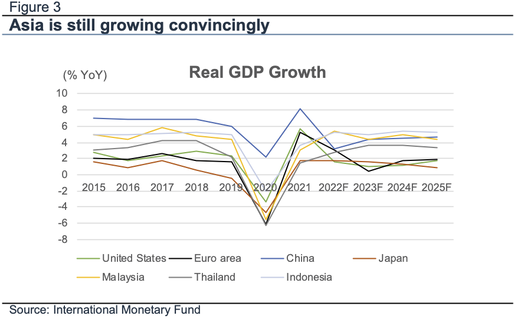
Needless to say, for us at Karrin Associates, it has been an interesting year navigating the markets of South East Asia where we saw first-hand the gradual return of life to travel and how that in turn impacted earnings. In this time, we officially made two investments into what we think are good quality long term businesses, one in the Malaysian convenience store industry and another in the ASEAN digital infrastructure space. While 2023 is looking to be another tricky year, the possibility of Asian economies decoupling away from that of the West appear likely as expectations are for the region to bounce back in growth relative to the West where options appear to be a soft or a hard landing recession. Against that backdrop we are carefully sanguine, looking at 2023 to provide us good entry points and with the margin of safety required for our investments in ASEAN.
Given the bearish scenario that we were and are still faced with, valuation divergence between public and private markets are more pronounced, causing a significant mismatch in the expectations of buyers and sellers in the private markets. In the past year, we witnessed larger/ profitable companies abandon capital raises while desperate cash-burning startups were forced to raise at lower valuations, many with steep discounts. A stand out trend which we also saw was the tapering of super-normal revenues for “Covid-winners” businesses, where it still remains to be seen if these new business models will withstand the return to normal life post Covid.
While the derating of valuations in the space that we occupy is seen as a positive given our phase of deployment, we continue to expect valuations in the private markets to soften as the reality of higher interest rates and slower growth sets in. The signals are there, all of which are firmly captured by the downgrading of growth and earnings expectations widely across the board, chiefly led by wide expectations of a potential economic recession taking place in the developed world. It is in this time of higher business costs where business models prove themselves, essentially separating the chaff from the wheat. Numbers coming through in 2023 will be telling.

Of course the fundamental global macroeconomic outlook away from monetary policy pivot expectations appear rationally bleak, but if there was a bright spot worth considering it would undoubtedly be the return/reopening/reinvigoration of China and what that holds for demand and the emerging markets as a whole especially after what has been a dismal year marred by currency devaluation. If this scenario plays out, it is likely that the risk rewards for Emerging markets and in particular ASEAN will improve immensely which could spur the decoupling away from that of the developed markets. This is our base case and in our opinion structurally backed by improving economic growth, trade and FDI flows into the region as ASEAN cements itself as a hub to fill the gap of the diverging trade relationship between the Western democracies and that of the “socialist” East. This trend continues to be one of the key pillars where we derive our bullish case on ASEAN and our anecdotal checks on the ground still appear to be supportive of this case.

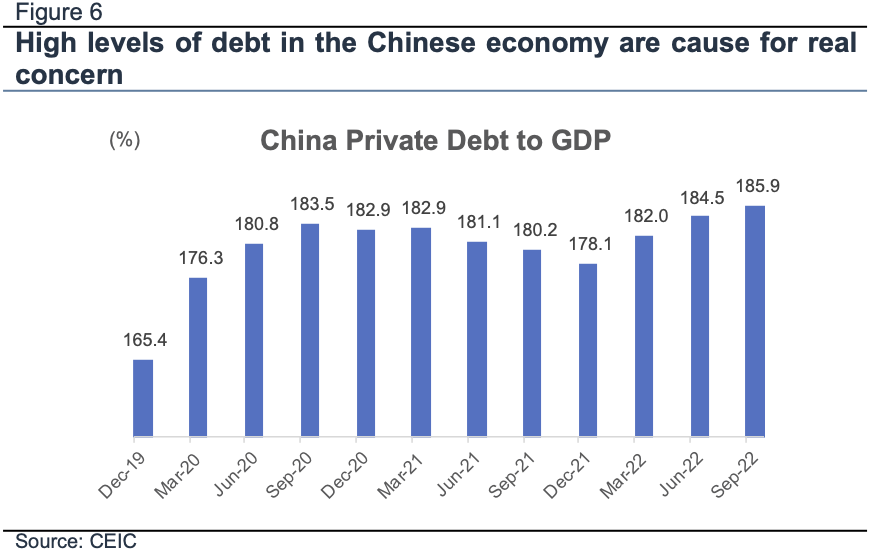
While there are good reasons to be bullish given China’s influence and impact on the global growth scenario, it is important to be realistic about its immediate prospects as the challenges that China is faced with are not straight forward. Curtailed in part by its own internal issues through leverage in the property market and the aftermath of a seemingly flagging demand scenario in local consumption given Covid lockdowns, further castigations from the West which largely ebbs the flow of trade, do not help. No doubt the call from the politburo for the Central bank to be supportive of business is resounding, it is realistic to assume that its likely path towards recovery in 2023 would be a non-linear process. While the oversold China/HK markets have rebounded with aplomb in 2023, these are early days and a sustained improvement of risk asset valuations will require actual tangible economic improvements.
 |  |
Alas, there have been enough warnings seen of late that the world is not operating on the same terms as it was before. The term de-globalisation has been touted frequently, and while we do not believe that such a drastic case would ensue, the world is definitely moving in that direction. As such the few non-normal and structural factors which we would be keeping our eyes on this year are predominantly as a result of this escalation of tension between the Western democracies and the Eastern bloc. These are :
(1) The return of structural system inflation (after decades of deflation) but this time a supply-push as price pressures from the de-globalisation of supply chains fester ;
(2) Increasing tangible evidences of trade moving away from US$ usage through alliances formed by various trade partnerships – If this should materialize meaningfully in 2023, demand for the safe haven that is the US$ could potentially wane;
(3) Energy and metals security – expect a rush to procure these and to see more diversification of sources of supply given potential ‘weaponisation’ from suppliers;
(4) The ability (or the lack thereof) to handle excessive debts in the system – for eg the shift from its ultra-accommodative stance by the Bank of Japan and how that impacts its ability to service its high debt level and to balance export competitiveness.

Yes, we live in turbulent times and practicing discretion in investment selection is absolutely paramount. While we maintain this careful discipline in our investment framework, it is also important to keep in mind that it is in turbulent times that generational opportunities present themselves. As such we are looking at 2023 cautiously optimistic for it to be a good year for deployment. It is with much excitement that I ask you to stay tuned to our progress at Karrin Associates in 2023.
Happy investing.
Author Certification:
All views presented above strictly reflect our personal views at the time of publishing. It should in no way be viewed as intending to dictate, advise in investment decisions or to solicit for business.
Important Disclaimers:
This document is produced and distributed by Karrin Associates Pte. Ltd. It has sole ownership over its materials and information provided in this document is strictly confidential. Any confidentiality breaches should assume any and all liabilities.
Information provided in this document is not audited and should not constitute investment advice or a recommendation. The recipient agrees that this document shall be used solely as references and not for any other purpose, commercial or otherwise. Any investment decision must be made solely on the basis of the recipient’s own due diligence. Karrin Associates and its subsidiaries, affiliates, controlling persons, directors, officers or employees do not accept any liabilities whatsoever for any decision taken based upon the material.