
China Biotech/Biopharma – From Copycat to Creator
For much of the past two decades, “Chinese pharma” was shorthand for cheap generics and bulk ingredients: the factory floor of the world’s medicine cabinet. That reputation is now badly out of date. When the world’s largest drugmakers go shopping for their next cancer or obesity drug, a growing share of their cheques are made out to Shanghai, Suzhou and Hangzhou. China’s share of the global drug development pipeline has risen from about 8% in 2015 to roughly 32% in 2024, and Beijing’s 15th Five-Year Plan now sets an explicit goal: first-in-class drugs from China should make up no less than a quarter of the global total, growing at 20% or more a year. Quietly, the sector is completing one of the more remarkable industrial shifts in Asia.
Policy set this in motion. In 2015, the drug regulator, the NMPA, reformed its approval process, shortening timelines and bringing standards closer to international practice. At the same time, volume-based procurement (VBP), a national tendering system for off-patent drugs, cut generic prices by 50–90%, leaving companies with a stark choice: innovate or shrink. Two other forces helped. Scientists trained in the US returned home in large numbers, and China built a world-class network of contract research and manufacturing organisations (CXOs) that runs trials and production faster and more cheaply than almost anywhere else.
Cost, however, is no longer the whole story. Increasingly, the value sits in the science itself: the chemistry that links drugs to antibodies in antibody-drug conjugates (ADCs), the engineering of antibodies that hit two targets at once, and the choice of new disease targets. That is capability, not cost arbitrage, and it is far harder to replicate.
The market’s path in 2026 has been anything but smooth. In the first half, investors crowded into AI and technology, and southbound flows into healthcare, which had turned to outflows in October 2025, stayed negative. Geopolitics also returned. In June, the Pentagon added WuXi AppTec to its list of Chinese military-linked companies, and in mid-July came the Biotech Investment National Security Act (BINSA), which would extend US scrutiny from contract service providers to the wider biotech investment and technology-transfer ecosystem. At home, an intensified anti-corruption campaign disrupted hospital sales channels, through which roughly 70–80% of China’s drugs are dispensed. The Hang Seng Healthcare Index hit its 52-week low in late June, then rebounded about 17% within two weeks, turned positive for the year and has since outperformed the Hang Seng Index. Through July, Chinese biopharma became the emerging-market growth trade of choice.
Why we like China biotech and biopharma
We see three reasons to be constructive: global pharma is buying, earnings are arriving and Beijing is backing innovation.
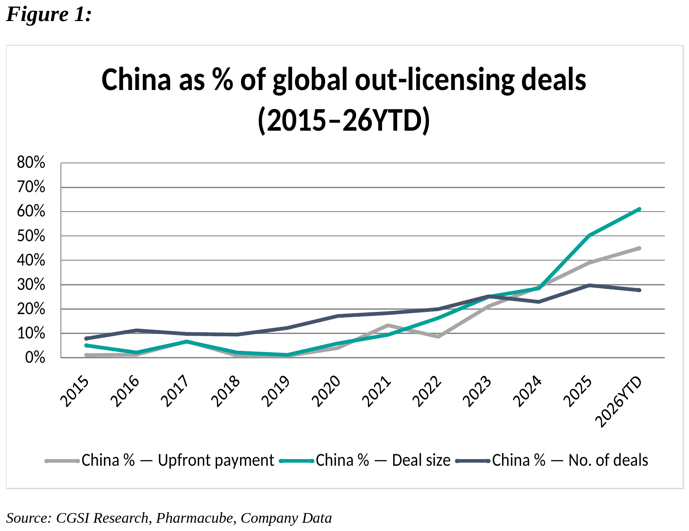
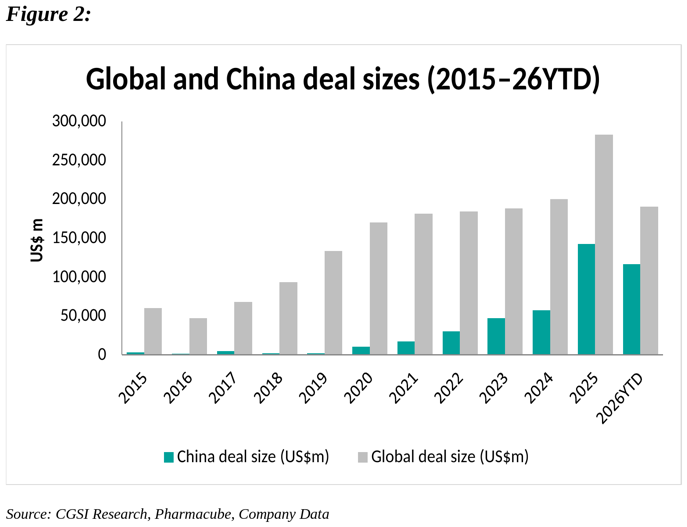
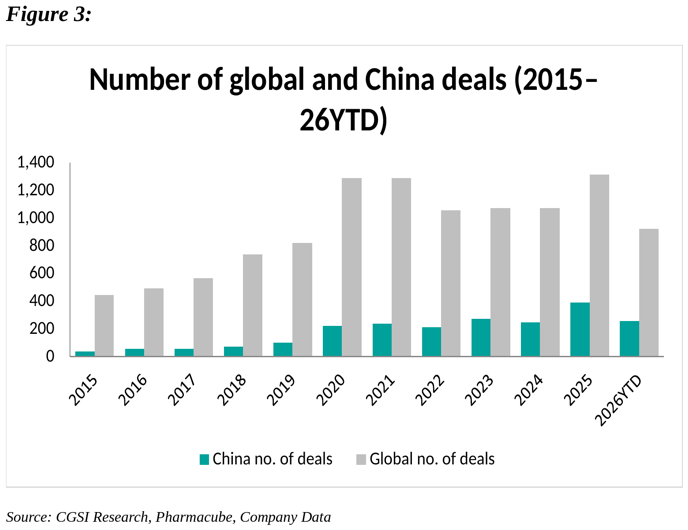
The world’s largest drugmakers are buying the science. China’s share of global out-licensing deal value has jumped from under 10% as recently as 2021 to about 60% so far in 2026, even though it signs fewer than 30% of the deals (Figure 1). The gap tells the story: each deal is getting bigger (Figures 2 and 3). Pfizer’s collaboration with Innovent covers 12 oncology programmes and is worth up to US$10.5 billion, while AstraZeneca agreed to pay CSPC up to US$18.5 billion for a portfolio of obesity drug candidates. Deals are also moving from single-asset licences to multi-asset bundles, with deeper partnerships spanning early-stage research, co-development and co-commercialisation. That points to growing bargaining power, and to global pharma buying a capability rather than a bargain. Oncology still leads, at roughly half of this year’s deal value. For Chinese biotechs, these deals bring in cash without issuing new shares, and deal flow has continued despite the geopolitical noise.
Earnings are arriving. The sector is graduating from cash-burner to cash-earner. BeOne Medicines grew first-half 2026 net income almost fivefold to US$464 million. Global sales of its blood-cancer drug BRUKINSA rose 35% to US$2.3 billion, and management raised full-year revenue guidance to US$6.6–6.8 billion. At Innovent, product sales rose 57% and net profit 50%, and its weight-loss drug mazdutide became the second-largest brand in China’s self-pay weight management market. As profits come through, investors can value these companies on earnings rather than on the hope of future drug sales, a shift that historically supports a re-rating. BeOne shows where that path leads: it re-rated as zanubrutinib (BRUKINSA) became the No.1 BTK inhibitor in the US. With out-licensing now an industry standard rather than a surprise, the next catalysts to watch are late-stage: pivotal trial readouts, regulatory filings and approvals in global markets.
Beijing is rewarding real innovation. Average price cuts for newly negotiated drugs on the core National Reimbursement Drug List (NRDL) remain steep, at roughly 60%. However, a new “Category C” pathway offers much gentler terms, with average price cuts easing to 15–50% for high-cost, cutting-edge therapies such as CAR-T, rare-disease and Alzheimer’s treatments. In July 2026, China also updated its National Essential Medicines List for the first time in eight years, adding 109 therapies that public hospitals must now stock. Policymakers are still squeezing old generics, but they are clearly protecting the incentive to innovate.
Selectivity matters
Not all of China’s healthcare sector benefits equally. Companies that rely on domestic generics and sell mainly through hospitals are being hit from both sides: VBP renewal rules for 2026–2028 have become less predictable, and the anti-corruption campaign has slowed prescriptions. We therefore prefer businesses with a high share of innovative drugs and a global commercial footprint, which are less exposed to domestic pricing policy.
We also like the large pharmaceutical groups that have built a biotech engine inside a traditional business. Their in-house pipelines are now strong enough to license to global partners. CSPC’s four out-licensing agreements with AstraZeneca since 2024 carry a combined potential value of about US$27.6 billion, and at Sino Biopharmaceutical, innovative drugs and out-licensing income together now make up about 45% of revenue. For these companies, licensing income cushions the decline of legacy generics, funds the next generation of drugs and shows that global partners value their science. That makes them a lower-risk way to own China’s innovation story, with the cash flows of an established business.
Across the rest of the sector, biotechs offer more growth, while the contract research and manufacturing layer offers more certainty because it gets paid whoever’s science wins. We see a case for holding both, but we lean towards the innovators, where the science itself is the moat.
Risks
The risks are real. Passage of BINSA is the key downside for the sector. Clinical trials remain binary events that can move share prices sharply in either direction. Competition is also intensifying between Western innovators and Chinese biopharma, with both sides racing to deliver higher-efficacy, highly accessible next-generation drugs.
Conclusion
We have little doubt that China biotech has earned its seat at the global table. The science is real, the buyers are the world’s largest pharmaceutical companies, and the earnings are beginning to show. That said, the road runs through Washington as much as Beijing, and volatility will remain part of the journey. We like the story, but selectivity and some patience will be required along the way.
Author Certification:
All views presented above strictly reflect our personal views at the time of publishing. It should in no way be viewed as intending to dictate, advise in investment decisions or to solicit for business.
Important Disclaimers:
This document is produced and distributed by Karrin Associates Pte. Ltd. It has sole ownership over its materials and information provided in this document is strictly confidential. Any confidentiality breaches should assume any and all liabilities.
Information provided in this document is not audited and should not constitute investment advice or a recommendation. The recipient agrees that this document shall be used solely as references and not for any other purpose, commercial or otherwise. Any investment decision must be made solely on the basis of the recipient’s own due diligence. Karrin Associates and its subsidiaries, affiliates, controlling persons, directors, officers or employees do not accept any liabilities whatsoever for any decision taken based upon the material.