

Law of Unintended Consequences
Central banking shenanigans
By the end of 2020, it is estimated that the world’s six largest central banks will have taken their balance sheet holdings from around $15 trillion to a whopping $25 trillion worth of assets. With an estimated $10 trillion by end 2020, the Fed is a key contributor to the $25 trillion worth of assets, injecting if you like $8.6bil / day and a professed ‘upper bound of infinity’. The ramifications to asset prices are immense and if the experience of the 2008 crisis had left the common man on the street disenchanted about the motivation of these institutions ostensibly put in place to protect the welfare of citizens, the 2020 edition would likely appear more disconcerting. The Fed chairman’s gloomy outlook on the economy over the last week, coupled with the unlimited resources it says it has, had us wondering just how far central banks will go in discharging its duties, the intended and unintended consequences of their actions, and what holds in store for the future of the modern central bank.

While it is almost always the case that governments (democratically elected or not) are induced into spending their fiscal allowances to its limit, central banks in turn exercise its monetary policy discretion in a measured act of socialism. If applied in the right manner, it serves to promote economic growth, a manageable inflation and a balanced wealth distribution across income classes. Widely there are three goals of a modern central bank by order of importance: (1) Stability in the value of money and price stability by ensuring sustainable rate of inflation (2) To sustain good employment and maintainable economic growth by smoothening business cycles (3) Financial stability by developing and promoting reliable payments system and the prevention of financial crisis. Because the role of central banks and its powers to print money give it limitless firepower, central banks are seen to be too important / holy to be influenced by the government of the day, often acting independently of the three branches of a modern government.
Taking a walk down history lane reveals a better understanding of the origins and evolution of these institutions. The earliest form of central banks were recorded in the 1668, when the Swedish Riksbank was incepted to lend funds to the government and to act as a clearing house for commerce. This principle of operation equally formed the basis of the birth of the Bank of England a couple of decades later, though others were formed for particular purposes. For example, the Banque de France by Napoleon in 1800 was formed to stabilise the currency after the hyperinflation caused by the French Revolution. While the motivation of inception may differ, the continuing role of central banks were fairly standard, that is help fund government, it was a lending platform between commercial banks and was also a lender of last resort during crisis. At the turn of the 20th century when most countries adhered to the gold standard, the role of central banks were extended to consolidate the various forms of currencies and to maintain a smooth balance of gold in its coffers by managing interest rates. Given that the value of currencies were pegged to the gold quantity and the perceived value it had in future, the role of central banks here were essentially to adhere to this gold standard thus ensuring price stability.
The US experience was somewhat different. Given America’s deep distrust of centralised power, the two central banks which were set up between 1791 – 1836 saw their charters left un-renewed, which led to a period of 80 years characterised by financial instability. There, banking licenses saw minimal regulations causing ineffective payment systems, varied forms of currencies and an absence of a lender of last resort in periods of distress. The 1907 Knickerbocker crisis, which saw numerous runs on banks and trust companies, led to the creation of the modern day Federal Reserve. It was given the mandate to provide a uniform and elastic currency and to serve as a lender of last resort. A key force in the history of central banking has been central bank independence, as the original central banks were private and independent institutions free to choose their own tools and policies.
While at its best, the independence of a central bank allows it to function in a manner devoid of any interference, at its worse, central banks have the ability to behave unchecked and unjustified, leaving ample opportunity to determine the fate of global economy, even if its actions are most unwarranted. Sadly the track record has been chequered with central banks being blamed in past recessions of being too slow in reacting, while in the financial crisis of 2008, the creation of an asset bubble from quantitative easing programmes and historically low interest rates (even negative rates in Europe) which the Fed themselves admit in The Financial Stability Report issued by the US Federal Reserve last Friday, to be the cause of ‘lessened investors concerns about default risks arising from higher leverage’. With complete disregard to the failures in the 2008 edition, the 2020 crisis at hand has been met with unprecedented amounts of liquidity, most drastic in the US, whereby “buying all manner of private and public debt – even junk bonds”, the Fed has expanded its balance sheet from $4.1 trillion in late February to over $7 trillion currently, inviting unnecessary risks into its balance sheet instead of allowing failing companies to rightly fail. This ‘Fed put option’, as referred to by the market, has served to diminish perceived asset risk premiums so excessively, where financial assets are at this point disproportionately detached from the fragilities of the real (failing) economy.
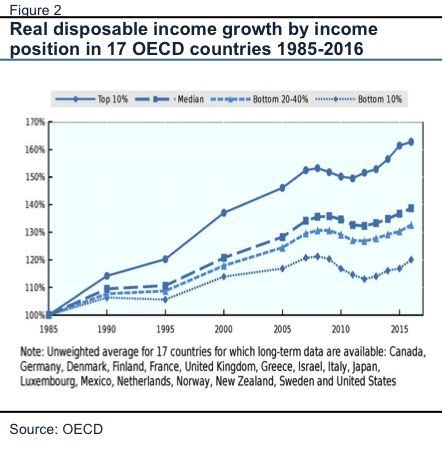 | 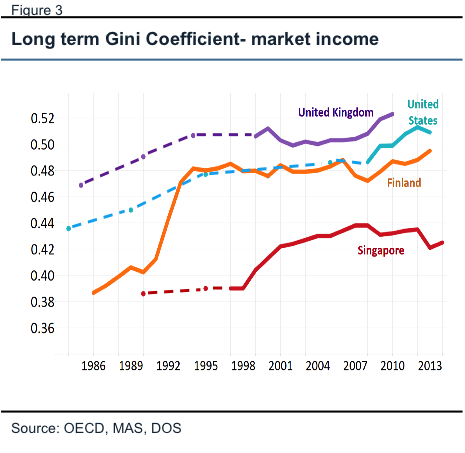 |
Of course, tough measures are required in combatting the Covid-19 shutdown, that said there are also unintended consequences that central banks have to consider and ultimately be held responsible for. One such area is the subject of increasing wealth disparity, where we view the 2020 recession to be followed by one of the biggest transfers of wealth from the poor to the rich, as it had experienced in the bank bailouts of the 2008 financial crisis, where Quantitative Easing and low / negative interests had caused asset bubbles in the property and financial assets space while growth in wages for the common folk remained only gradual. This is evidenced by the chart above, clearly showing an increasing Gini coefficient in the developed world especially after 2008, indicating rising disproportionate wage / income growth across income groups. Much of this ‘state sponsored’ wealth accumulation for the select few will once again take place in 2020 as financial asset holders are not only bailed out but further enriched with increasing asset prices, while job losses continue to haunt the low to middle class. With fiscal budgets and debt level bursting at its seams, the government will somehow have to accommodate this shortfall which essentially only means higher taxes should be a base case in the coming years.

We are firm believers that key factors in determining the wealth of an individual are the society and economy around them. Being part of society, we depend on the collective will of the people guided by good governance of assets / liabilities to enable trade, jobs, fair wages, access to healthcare, education and basic necessities. In this regard, it is imperative that governments and institutions ensure that the shared wealth of society is placed ahead of the wealth of a few. They should ultimately do this by ensuring an appropriate implementation of fiscal and monetary policy aimed at ultimately boosting the economic outcome of their respective society – we have seen in the case of Europe that separate implementations of these policies do not work. Looking at the figure above, it is clear that the ultimate outcome of welfare is directly impacted by government initiatives, and while natural resources help, wrong policies will serve to destroy. In this regard, we believe that the central banks’ ability in formulating functional and fair policies will be questioned like never before. As it has in the past, perhaps the years ahead will see further transformation in central banking roles, which should hopefully call for more scrutiny in its policies and actions, especially if the ever-growing left wing agenda takes further shape in the generation ahead.
Other musings: Oil, interesting Covid 19 diagrams, new consumer norms.
Oh what a week – we heard from the horse’s mouth of Mr Jay Powell in his negative guidance on asset prices and the economy, high >25% unemployment but his ruling out of an economic depression. We saw more US-China friction specifically on Huawei, expectedly weak retail, production and jobs numbers, and threats of second waves of Covid-19 virus in various parts of the world. On the brighter side of things, much to look forward to this week with oil staging a well justified rally and the world seeing some positive light in vaccine test results adding to continued store openings like the 25 Apple stores in the US, school reopening in China, which has seen close to 40% of students (100mil) return, and overall higher traffic seen in main cities in China despite news of further Covid-19 reinfection threats.
On the subject of oil, as we had presented in (Un)clear and Present Danger on 13th April 2020, the 9.7 mil bbl/day production cuts in May and June that have been put in place by Opec+ should be seen as a positive signal for oil. What has further helped since then is talks that the Opex+ could potentially maintain these low production throughout 2020 and the surprising move by US producers to equally cut production leading to a surprise inventory draw last week in the US. The combination of lower supply and demand slowly trickling back to the market has given the EIA sufficient justification to now (on 7th May 2020) expect an inventory draw of 3-5 mil bbls in Q3 and Q4 2020 globally, an upgrade from its rather gloomy expectation before of a 0-2mil bbl draw respectively. While it remains to be seen if there are indeed valid reasons for a continued bullish uptrend in oil prices, the resurgence of some balance in the market should bode well for price support.

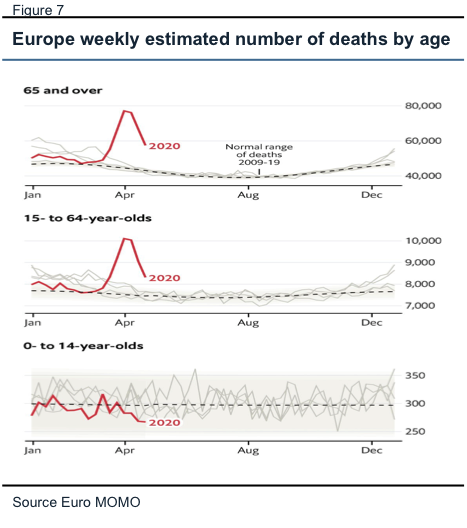
Per our previous notes, seeing countries come back into business should be seen as a plus. That said, while positivity surrounding the virus has quickly injected some confidence on the humanitarian outcome, it is most interesting to draw similarities with that of the Spanish Flu, a useful reminder that running afoul of proper hygiene and post quarantine safety measures will lead us straight down a harrowing path indeed.
 |  |
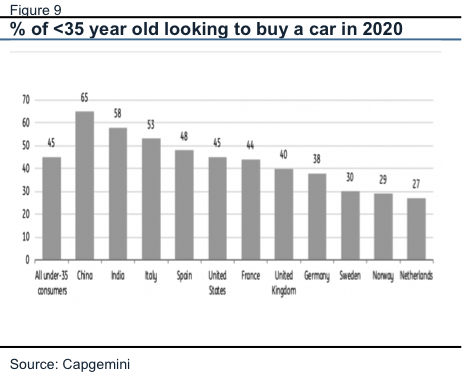
Avoiding a second plague means adjusting to new norms in conducting our daily activities. Exercising and commuting on public transportations have both become contentious subjects and these will lead to changes in behaviour and in the perspective of many <35 years of age, the purchase of a new car. Interestingly, this week, the author participated in an online auction for golf equipment on Facebook by a well-known golf vendor. As offline stores remain out of bounds to many consumers, the online business for even traditional type businesses will have to take shape, this potentially even leading to higher returns vs the investment needed.
 |  |
Author Certification:
All views presented above strictly reflect our personal views at the time of publishing. It should in no way be viewed as intending to dictate, advise in investment decisions or to solicit for business.
Important Disclaimers:
This document is produced and distributed by Karrin Associates Pte. Ltd. It has sole ownership over its materials and information provided in this document is strictly confidential. Any confidentiality breaches should assume any and all liabilities.
Information provided in this document is not audited and should not constitute investment advice or a recommendation. The recipient agrees that this document shall be used solely as references and not for any other purpose, commercial or otherwise. Any investment decision must be made solely on the basis of the recipient’s own due diligence. Karrin Associates and its subsidiaries, affiliates, controlling persons, directors, officers or employees do not accept any liabilities whatsoever for any decision taken based upon the material.