

Champagne Supernova
Negative interest rates and its implications
Caught beneath the landslide of many firsts, the U.S. Federal fund futures, a gauge on where investors expect Federal fund rates to go to, pointed at a negative territory on Friday (8th May 2020) for late 2020-early 2021 delivery. While we continue to believe that the Fed will not pursue a negative interest rate policy and that there is every chance for expectations in the futures market to not materialise, the very fact that these figures are cropping up combined with the limited interest rate buffer at the Fed’s disposal, lead us to explore this possibility even if it seems at this point to be a low probability event.

The hallmark of a typical modern central bank system is in setting policy rates consistent with the concept of neutral rate of interest, essentially setting a policy to promote stable inflation for the future. That said, the curious problem the Fed (and other G7 central banks) is grappling with is that an absence of inflation coupled with near zero interest rates leaves very little room to maneuver. Clearly, its failure to raise interest rates in a good economy in 2018 has led the Fed to this quandary and while it would seem unlikely for the Fed to adopt a negative interest rate environment at this point, we do wonder whether the unpredictable situation of this virus would inadvertently force the hand of the Fed in search of inflation. This is in stark contrast to China where big banks reserve requirement ratio of 12.5% and a largely orthodox monetary policy with key policy rates at 3.85% allows for a more aggressive monetary stance to combat poor credit growth.
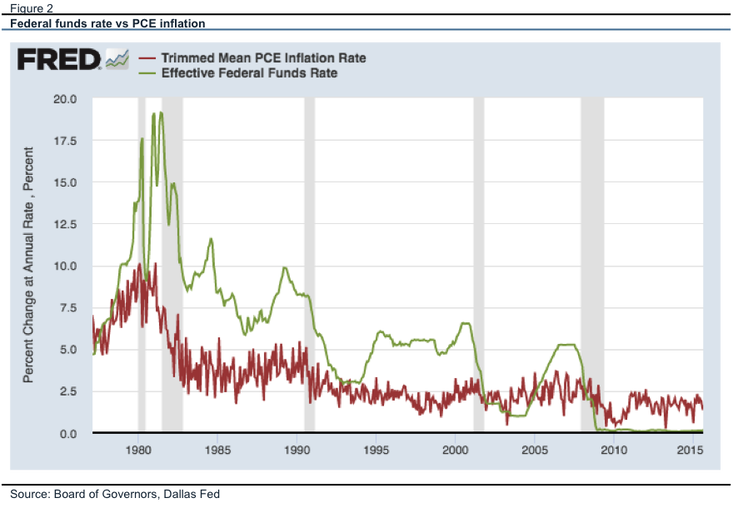
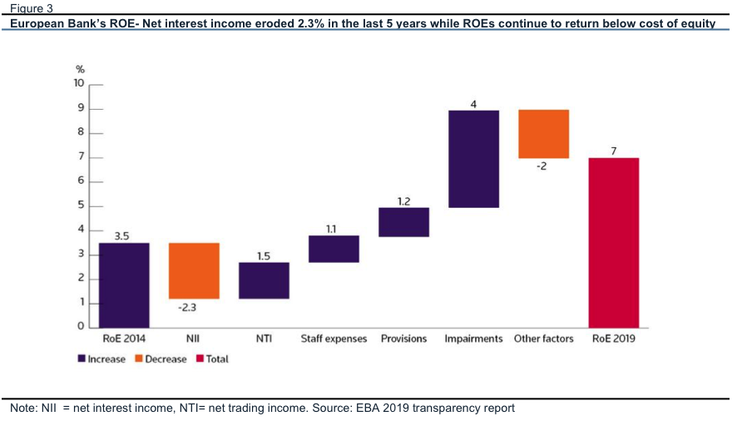
Being paid by banks to take a loan is one of three wishes the author would ask a genie if presented the chance, but for some in Switzerland, that is already the case. This concept, and the fact that savers may have to pay money to keep their savings at the bank, seems almost bizarre to say the least. Needless to say, even though this has been ongoing for some 5 over years in Europe and Japan, this exercise remains highly experimental without clear evidence that they succeed in helping the economy out of a doldrum. In fact, the few who have used it, namely the ECB, some European central banks and the Bank of Japan, have neither displayed success in reaching targeted inflation nor has it seem to have promoted consistent economic growth. The drawback is, as it has been proven difficult for the Fed to raise interest rates in 2018 even when the economy looked encouraging, that the stickiness of negative rates remain when growth stalls. At that point, monetary policy would likely be ineffective and that commercial banks would be well and truly in a bad shape.
The key issues with negative interest rates are that it could very well do the exact opposite to what it is expected to do, that is to encourage lending. The reason for this is due to margin erosion as (seen in European banks) banks would at that point be reluctant to pass on negative savings rate to their customers for fear of losing deposits but on the flip side still be hit by a lower rate of lending. This surely deters banks from wanting to lend especially in a Covid-19 scenario where default risk would likely not be commensurate with the returns garnered. To add to the complexity, the pricing of risk would be severely crippled given the fact that asset pricing models such as the CAPM, Risk Parity, DCF, Black-Scholes, to name a few, are all ill equipped to handle a lasting negative interest rate environment.
Even if policy rates remained positive, the April unemployment figures of 14.7% while cheered by the public markets for being ‘better than expected’, drove 2 year treasury bills to record lows of 0.105%, prompting concerns if this could also turn negative. This could very likely happen- as investors demand more of an instrument, the addition of the coupon annuity and the final return of principal at maturity results in a loss simply because the sum paid at inception was too high. This unattractive return juxtaposed against a large debt pile with a high foreign ownership of these bonds opens the USD up to more external risks that it just do not need at this point.
Our explanation above captures the reasons why we think the Fed would reject a negative interest rate environment, which we believe commentary from Jerome Powell this week will reflect. That said, like its European and Japanese counterparts who were somewhat faced with similar options from persistent low inflation, growth has to return in the US, and with some quantum. Otherwise, faster than a cannonball, this brief dalliance with negative interest rates quickly turns into a rude awakening, placing the cart well before the horse, once again.
Interesting charts we saw this week
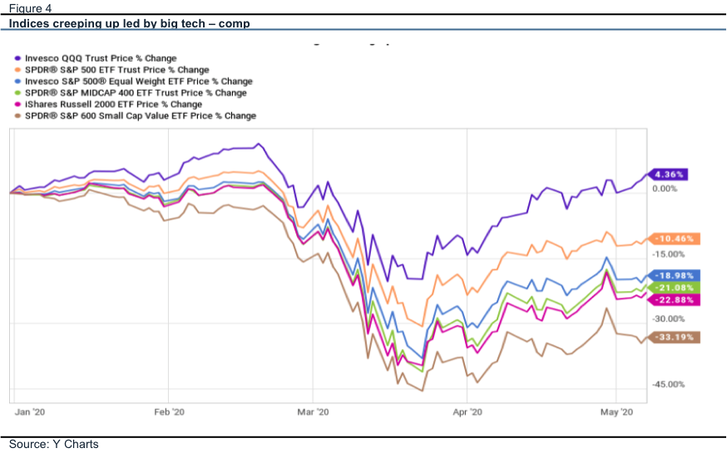
Its been a riveting week with economies slowly opening up while major public market indices continue its diverging path away from the real economy, led by Covid-19 beneficiaries in tech names. On the private markets, listed private equity firms such as Apollo Global, Blackstone and Carlyle Group have reported some ugly numbers from marking to market, but as these firms typically realise value over time, appraising the long term prospects of its investments would be a more accurate gauge of its performance. Some of the interesting charts we saw this week, which have investment implications are presented below.
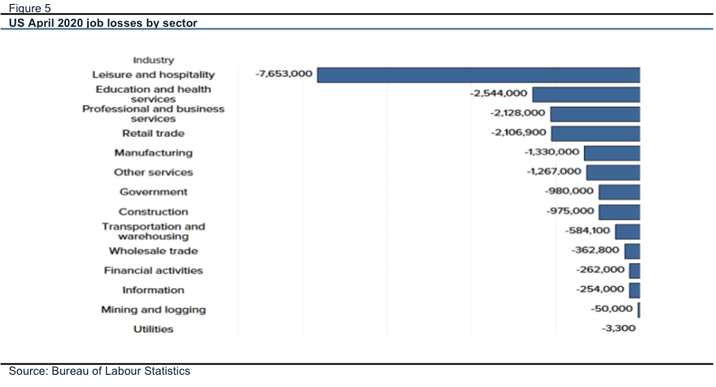
The backward looking April jobs data were bad (though seen by the public market as better than expected) seeing 20.5 mil American jobs lost in April leading unemployment rates to 14.7%. The usual suspects are there but caught beneath the landslide are education and healthcare which saw steep job cuts with 2.5 million lost, a majority of this interestingly from the healthcare sector (probably from elective/ routine type). The few industries, which gained jobs, were (amusingly) Central Bank (+0.51), Computer and Peripheral equipment manufacturing (+4.7%), Couriers and messengers (+0.21%), highlighting some positives from an otherwise moribund set of data.
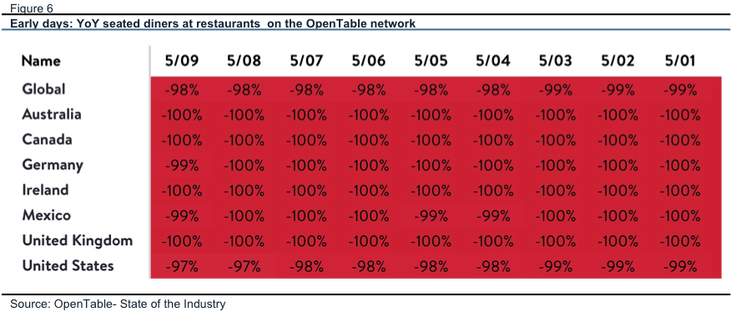
A key area which we have been watching, is consumer behaviour where positive talks of Carnival Cruises and Shanghai Disneyland seeing surges in its new bookings/openings were interesting anecdotes (we are cynical) – we are looking out for auto, property, construction, travel demand. At the dining industry, things still appear slow with only marginal improvement in overall dining demand. This data shows year-over-year seated diners at restaurants on the OpenTable network across all channels: online reservations, phone reservations, and walk-ins. This dataset is based on a sample of approximately 20,000 restaurants that provide OpenTable with information on all of their inventory.
Mr Warren Buffett and his investments have seen better days as he announced hefty USD50bil 1Q losses shattered by its investments in airlines. The Buffett Indicator, which measures the US market cap over GDP has been a good indicator of bear markets in the past. As this metric continues to flash warning signs, it remains to be seen if this theory will hold true in this Fed induced market. At the very least, this chart perhaps explains the huge cash hoard and the lack of action by the Berkshire Hathaway crew in this crisis.

A major risk factor which could impact markets this year, is the China – US relations covered in our past publications. While the Phase 1 trade agreement is in play, we see that China has a long way to go in meeting the 2020 target set at the Phase 1 agreement. We expect significant improvement in China’s buying, but equally expect China to miss this rather large USD200bil target this year. Perhaps that ‘natural disaster or other unforeseeable event’ clause might just kick in here, and it remains to be seen if Mr Trump would want to accommodate.

The world has not been short of devastating news over the last couple of months. That said, one good to come out of this is the impact to the environment – we have all seen the clear waters of Venice. The International Energy Agency reported an enormous 2.6 billion metric tons of CO2 not emitted during the period of the Covid, a sum larger than all major crisis events in the past. While this is a positive, this colossal figure displays just how big the negative impact human activity has on the environment. Dare we suggest the return of the carbon credit market? We are closely watching.

Author Certification:
All views presented above strictly reflect our personal views at the time of publishing. It should in no way be viewed as intending to dictate, advise in investment decisions or to solicit for business.
Important Disclaimers:
This document is produced and distributed by Karrin Associates Pte. Ltd. It has sole ownership over its materials and information provided in this document is strictly confidential. Any confidentiality breaches should assume any and all liabilities.
Information provided in this document is not audited and should not constitute investment advice or a recommendation. The recipient agrees that this document shall be used solely as references and not for any other purpose, commercial or otherwise. Any investment decision must be made solely on the basis of the recipient’s own due diligence. Karrin Associates and its subsidiaries, affiliates, controlling persons, directors, officers or employees do not accept any liabilities whatsoever for any decision taken based upon the material.