
Thailand – Darkest Before Dawn
Routinely a bustling destination for both leisure and business travelers alike, the “land of smiles” has in the last few years been anything but. Prominently beleaguered by a shaky political landscape coupled with US-China trade disruptions to its manufacturing supply chain, its dependence on the handsomely lucrative external demand, particularly from tourism which has historically contributed a large c.12% (in 2019) of GDP, is today proving to be its achilles’ heel with the Covid-19 pandemic thrown into the mix.
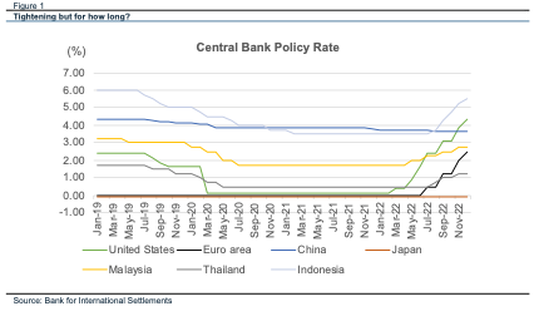
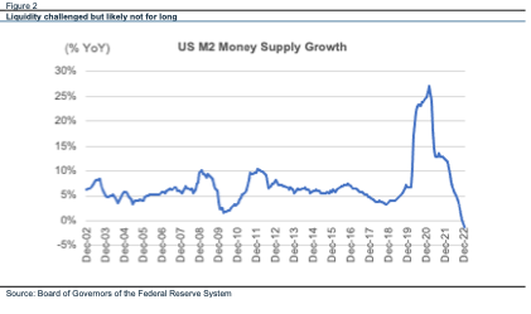
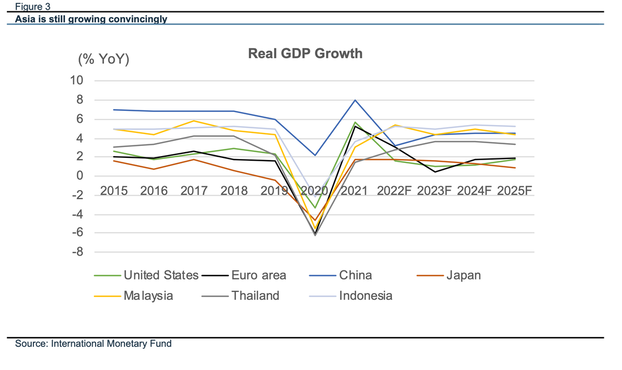
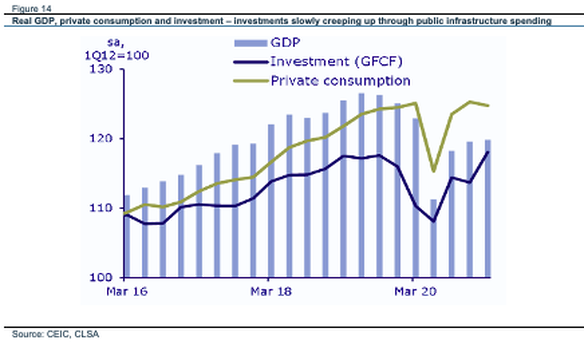
The absence of some 40 million tourists (close to 60% of Thai population) expected to arrive in 2020 added with lower domestic demand, has put to the sword Thailand’s services sector, bruising entertainment, retail, hotels, restaurants and spilling over to other industries as well. Not helping are also ongoing events such as the youth-led calls for Prime Minister Prayut Chan-O-Cha’s resignation, constitutional reforms and changes to the once-untouchable monarchy, all of which have collectively led to the hesitance of foreign investors towards Thailand over the last few years. Despite the 1.9 trillion Baht stimulus package, the economic impact has been severe, leading to widespread job losses for middle-class households and the poor alike. The consequence of this is a -6.1% real GDP contraction in 2020 with a 2.6% YoY contraction (+0.2% QoQ) in 1Q21 signaling a weak sequential growth, alarming given the further pain expected in the rest of 2021 from the resurgence of Covid-19 infections in 2Q21 and new doubts on political stability.
Notwithstanding the official Thai 2021 economic growth expectations of 1.5-2.5% (cut from 2.5-3.5% due to the 2Q21 Covid-19 outbreak), it is increasingly safe to assume that given the continued slow vaccination rate of 1.6% as at end May 2021 (3.6% at least one dose), the absence of a strong tourism recovery and a stable operating environment for investments, the 2021 GDP rebound in Thailand, if any, will likely be minimal in comparison to other Asian economies. The scars are exhibited through the depreciation of the traditionally strong Thai Baht against a weak USD in the last 6 months, as its ever-reliable Current Account surplus took a tumble towards a deficit.
Thailand’s vulnerabilities have been laid bare and against the backdrop of the current economic data, it is indeed notable. That said, if the belief is that the existing health pandemic is temporary (even if it feels like forever), then the implication of a return to normality should also catalyse a cyclical return for Thailand considering its geographical allure, size of the economy (2nd largest in ASEAN), relatively large population (c.70 mil people) and a readily available and connected manufacturing supply chain. Assuming this as the base case, then Thailand has all the necessary ingredients to finally make a breakout after its few years of under-performance, a key beneficiary of the “re-opening” if you like.
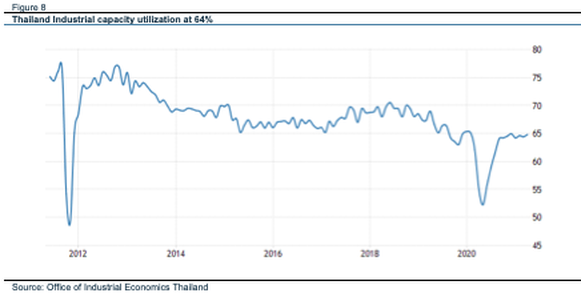
If the cyclical appeal of Thailand is evident, the solutions to its structural issues seems less so. Chief to that is the continued absence of substantial private investments, which is in many ways caused by the political turmoil it has faced in the last few years and the ensuing impact it has had in impeding the progress of a much-needed infrastructure rollout. With these interruptions in place and added with social unrests sparked by the large and growing wealth inequality (4th worst in the world on a Gini Index), FDIs have stalled.
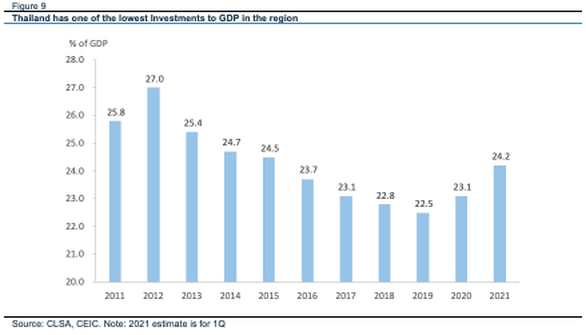
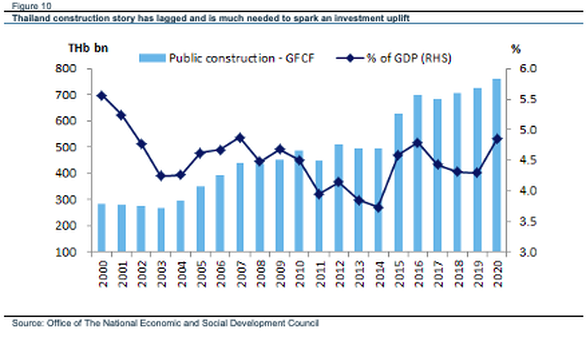
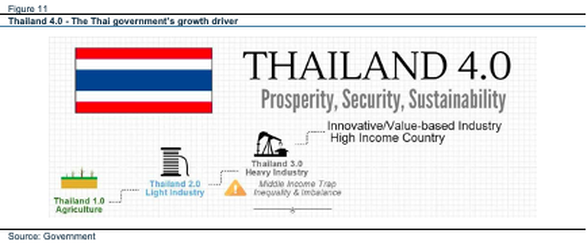
There are however reasons to believe that the agenda of Thailand’s democratically elected military government is skewed towards growth. Through a manageable public debt to GDP of 53% in 2020 which are nearly all domestically funded and long term, the government has the necessary medium term tools to launch growth projects, lending credibility to its ‘Thailand 4.0’ plans aimed at boosting short-to-medium-term economic growth and productivity through industrial transformation. To help realise this dream is the establishment of the Eastern Economic Corridor (EEC) in eastern Thailand which will see c.USD43bil investment from 2019-2025 in among others, a new international airport, expansion of seaports and land transportation network to its fast growing neighbours. Through this it is expected that investments from foreign investors will follow suit and for existing Thai industrial entrepreneurs to further innovate and invest.
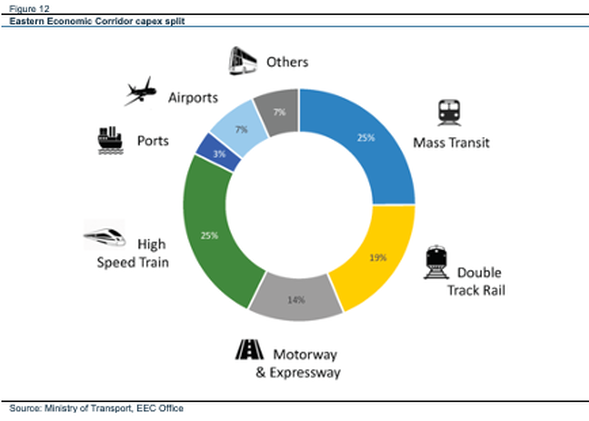
As Thailand stands to benefit from the US-China trade spat where the rerouting of supply chain will spill over to Thailand, this EEC drive from the government is timely and has already translated to investments from Electric Vehicle (EV) automakers like Great Wall Motor and Foxconn, EV charging companies like Evlomo Inc, and other industries like Chinese tire manufacturers, Harley Davidson, Sony, Sharp, and Delta Electronics, to name a few. Thailand’s improvement in the World Bank’s Ease of Doing Business to 21 out of 190 in 2020 is also likely to support, and with this it is conceivable that even if the c. 300 bil Bhat expected in investments for the ECC this year may be delayed due to Covid-19, it would probably not be long before these get deployed in Thailand. Further government support is at hand with attractive incentives of income tax breaks for up to 15 years, reduced personal income tax rate of 17 per cent and a 50 per cent reduction in corporate income tax rates over a maximum of 5 years.
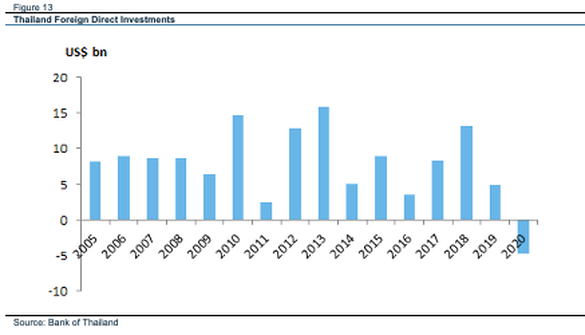
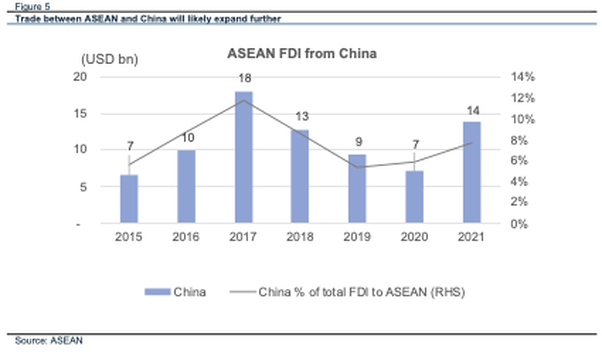
Positively, while the government has in the past acted cautiously towards Chinese investments (and the Chinese equally unhappy over the Phuket boat accident incident), the current fiscal constraints from Covid-19 has soften its stance. One such example supportive of this is the recent agreement in March 2021 (after 7 years of discussions) to kick start a USD0.4bil JV with China’s CSCEC in March 2021 for the initial section of the China-Thailand highspeed rail. This could just be the catalyst needed for a further Chinese investments especially when considering that c.28% of tourists to Thailand in 2019 are Chinese.
Notwithstanding the structural and cyclical issues in Thailand, activities in the Thai stock market continue to be active, proving to be a reliable source of fund raising for companies. After a strong 2020, the Thai IPO market appears on track for another record year in 2021 as its capital markets remain liquid, churning out 14 IPOs year to date totaling USD2.9bil in value with a stronger 2H2021 expected given the pipeline. This figure is already above the full year average of USD2.8bil seen in previous years according to Dealogic data. Similarly, the Thai start-up scene has also recorded a high of $364 million in 2020 (>3x YoY), though the number of deals dropped from 45 in 2019 to 33 (probably Covid-19 related) in 2020, according to Techsauce, a tech media outlet.
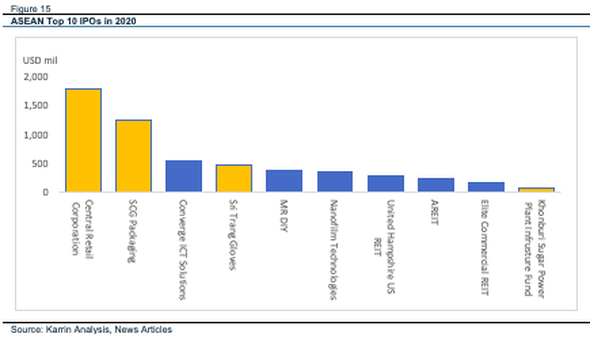
It would appear as though the Stock Exchange of Thailand (SET) continues to be accommodative towards new listings local and foreign, and this appeal will only increase particularly if the mulled SME exchange which would enable SMEs and startups to raise funds, materialises. Should this be the case, exit risks for investments into Thailand will severely moderate, making it an even more attractive playing field for private equity investors like Karrin Associates.
In summary, the medium term outlook for Thailand appears good and to contrast this against its widely successful move in the last 3-4 decades towards upper middle income (poverty rate from 65.2% in 1988 to 6.2% in 2019 ) through an economic transformation from agriculture to manufacturing for exporting, suggests that Thailand could just well continue in this positive trajectory. For now, valuations in Thailand appear moderately attractive given the aforementioned near term irritations which could likely linger to 2022. That said, if the execution on the ground of Thailand 4.0 is sufficient to help Thailand bank on its path back towards both cyclical and structural economic growth, Thailand in our books has many ingredients required of a market worth backing. The time to look is now, when it is possibly getting to its ugliest.
Author Certification:
All views presented above strictly reflect our personal views at the time of publishing. It should in no way be viewed as intending to dictate, advise in investment decisions or to solicit for business.
Important Disclaimers:
This document is produced and distributed by Karrin Associates Pte. Ltd. It has sole ownership over its materials and information provided in this document is strictly confidential. Any confidentiality breaches should assume any and all liabilities.
Information provided in this document is not audited and should not constitute investment advice or a recommendation. The recipient agrees that this document shall be used solely as references and not for any other purpose, commercial or otherwise. Any investment decision must be made solely on the basis of the recipient’s own due diligence. Karrin Associates and its subsidiaries, affiliates, controlling persons, directors, officers or employees do not accept any liabilities whatsoever for any decision taken based upon the material.