

The Asian Consumer (Part 2 of 2): Evolving Consumer Behaviours
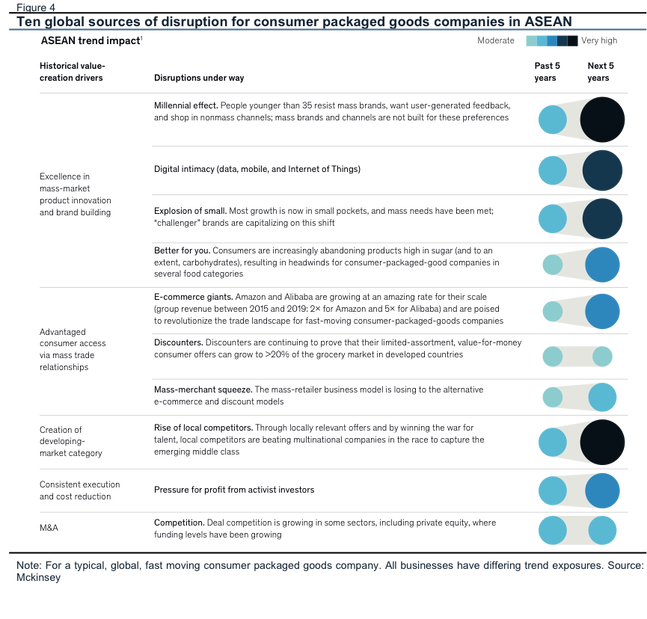
The millennial generation accounts for 27% of the world’s population or c.2 billion people. Interestingly, about 58% of these millennials live in Asia making that c. 1.2 bil Asian millennials. These individuals are today sophisticated, socially aware, tech savvy, are expressive of their opinions and are open to change. It is therefore no longer sufficient for companies to ascertain what consumers buy when income rises, but to ensure continued relevance and success, there is a need to understand the values, behavioural quirks and evolving trends, all of which have huge implications towards the success of marketing products in Asia.
Following on from The Asian Consumer : A Rising Tide (Part 1 of 2) published 16th of June 2020, where we had offered a bullish medium to long term thesis on the Asian consumption story, this Part 2 edition dives into examining the various idiosyncrasies and emerging trends within the Asian consumer space, an area unsurprisingly heavily influenced by the behaviour of these said millennials.


Behavioural differences
While the overall bullish thesis of the Asian consumer appears to be straight forward, that rising income and population is shifting the curve towards higher per capita consumption of goods and services, drawing parallels to consumers of the West in determining the purchasing patterns of the average Asian consumer would be misleading. This is because the average Asian consumer is influenced by embedded proclivity such as cultural values, economic environment, political circumstances, hierarchy within society and others. We see two clear distinguishing factors of the Asian consumer which we breakdown below under measured individualism and the contradiction.

Measured individualism : All around the globe and in particular, the Western world, millennials are driving the rise in individualism, leading a drift away from traditional institutions—political, religious and cultural. Marriages are taking place later, the appeal of religion is fading and common place ideologies are slowly being rejected with millennials asking the ‘why’ question. What takes place is instead this concept of individuals revelling in their own identity, away from the pressures of societal norms. While this may be true and in fact the modern Asian are not somewhat beholden to values or cultural tendencies from that of their parents, the Asian individualism takes the form of a milder touch, not veering too far way from the shared goals of society. For example in Asia, the admiration for rebels does not really exist because rebels cross the line and risk becoming ostracized, especially when they are viewed as a nuisance.
While the West have been in the past key opinion leaders of what makes a modern society, the prevalence of the East looking to the West for answers is today quickly reducing in relevance. Great modern cities are found in many Asian countries and if decades ago, a T-shirt with a label of London or Paris would aim to stoke aspirational vibes towards what is luxurious or modern, it is no longer as straightforward. Today, Western brands, while still inherently influential, are slowly seeing a move towards patriotic identities, precipitating the need to localise content as the Asian millennial is comparatively more patriotic than the Western millennial. In fact, consumers in Asia are today more accepting of local improvisations / flavours and are as much influenced by the East (Japanese and Korean) as they are of the West. Brands coming into Asia can no longer rely on the fact that they are bringing the “New York lifestyle” to Asia, rather there is a need to curate products in Asia for Asia.
There is also little evidence of ‘youthful individualism’ as the hierarchal setting is ultimately still in play and the desire to climb this social hierarchy remains as present today as it was in the past. In this respect, marketing to such a mindset requires tweaking and not mere adoption from what works in the Western world. For example in China, a revered “Superhero” in a Chinese context is not one who possesses supernormal powers but is one who is hard working and achieves success through years of mastering his or her craft. Getting these nuances right is vital and to give a perspective of just how vast this market is, in the finale of the globally popular Game of Thrones series aired on HBO, a record breaking 19.3 million viewers tuned in, a whopping number by any imagination. Enter China where the series of The Story of Yanxi Palace, co-produced by China’s biggest streaming platform iQiyi and production company Huanyu Film saw 530 million views on 12th August 2018 setting a record for highest single-day online viewership.
The contradiction: Professor Bernd Schmitt in his book titled “The Changing Face of the Asian Consumer,” quite eloquently explained the contradictory desires of the Asian consumer as “Value Shopaholics, Functional Hedonists, and Traditional Futurists”. In short, Asians like buying things but they seek value, they like brands but only for those that really matter and while they aspire to be regarded as modern, traditional value systems are still in place. A good example of this is the perception of value and how it is so common for a Chinese tourist holidaying in Paris to buy expensive Rolexes, famously queuing up at Louis Vuitton in Champs-Elysees and finishing the day dining at one of Paris’ finest restaurants. However instead of staying at a lavish hotel, they would probably opt for a no frills 3 star hotel in Montmarte and would avoid the minibar at all cost.
This pragmatism towards what constitutes ‘value’ defines many consumers where high importance is placed on branding (and the brand experience) of what is deemed important and for everything else a question of need over want, regardless of how deep the pocket. Nielson in its “Changing Consumer Prosperity” report published in 2019 reached a similar conclusion whereby it was stated that while Asian consumers are cost conscious often looking for bargains, they are also the most willing to pay a premium for certain product categories where an overwhelming 49% respondents in Asia Pacific opted for premium personal electronics (49%).
Evolving trends of the retail business
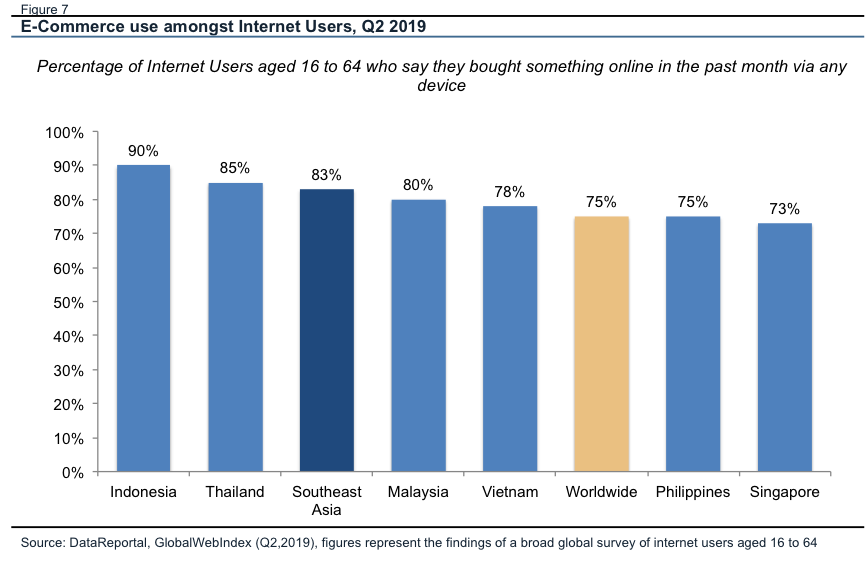
With many confined to their homes during the Covid-19 virus, evolving trends over the last years in particular through digital means have accelerated. Businesses in Asia which have relied on traditional channels and, in particular, that of the ‘brick and mortar’ type have and will have to recalibrate their businesses to allow for the digital world whether on the sales, marketing or at the operating end. Customers’ expectations are also changing and centre to this is the access to information and the marketplace at a click of a button. While adoption is already elevated at the developed Asia end, Emerging Asia and in particular ASEAN, is still low but quickly growing.
As the retail business place evolves at a rapid phase, the likelihood of consumers keeping their ‘stay-at-home’ retailing habits is high. Businesses that ignore these signs choosing to write this off as merely a phase will learn to their detriment that the basic requirements needed to satisfy their customers have and will continue to evolve away from the traditional standard.

 |  |
The digital economy taking shape
The joint ASEAN digital economy research report by Google, Temasek and Bain titled e-Conomy published in 2019 afforded a bullish case for the ASEAN digital economy where it expects growth at an unprecedented rate to USD300bil by 2025 with the market having hit a USD100bil milestone in 2018/19. This is led by growth in Indonesia and Vietnam with >40% YoY additions and others like Malaysia, Thailand, Singapore and the Philippines between 20-30% annually. Showing over 100mil addition in internet users (many are youths aged 15-19 years of age) over the last 4 years in ASEAN, the expectations is for the region to hit 480 mil internet users by 2020 or c.74% to the total population where roughly 90 percent of these users surf through their smartphones. ASEAN consumers spend more time on mobile internet, (3.6 hours a day- Thailand highest at 4.2 hours/day followed by Indonesia at 3.9 hours vs the US at 2 hours per day), they are young (median age of 29 years) and have improving income levels, all of which bodes well for the future of the internet economy in the region.
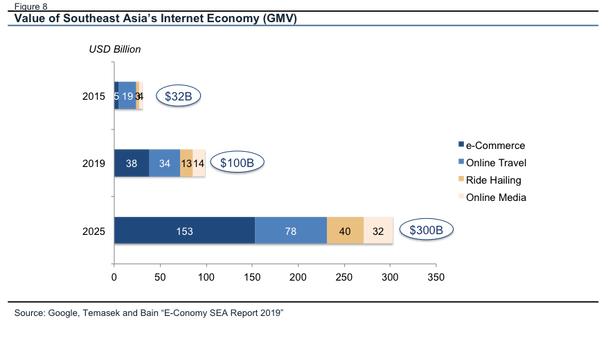
This rapid change is already taking place as seen in e-commerce activity where 2019’s Gross Merchandise Value (GMV) for the Southeast Asian region of USD38bil, almost seven times the USD5.5bil seen in 2015. Online delivery services, contactless shopping and cashless transactions continue to grow in folds across Asia, as major chain stores see customers opt for those services when made available. Trends like these are driving a vast uplift in deliveries businesses such as Grab, Gojek, Angkas, Meituan etc. and in online market place such as Shopee, Lazada, Tokopedia where these players are all seeing notable surges in GMV.
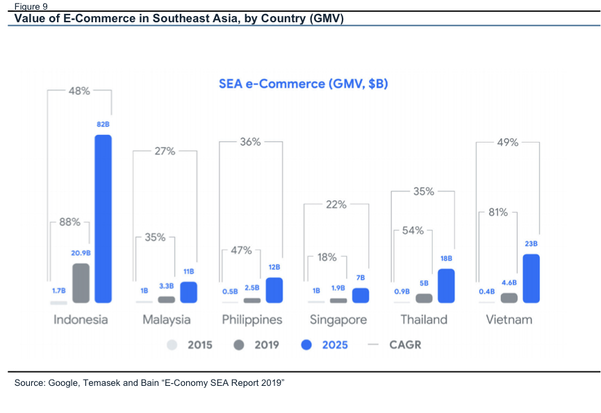
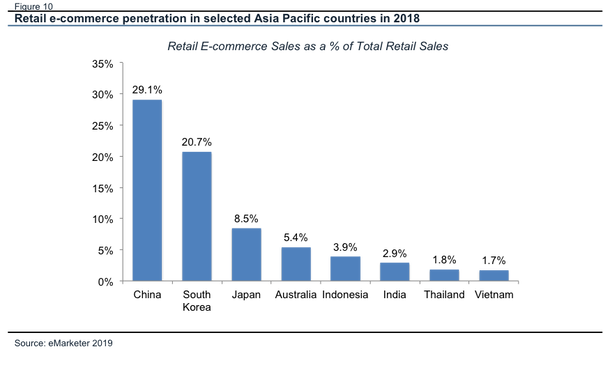
Social media is also fast evolving into a mainstay business place. In a survey of 4,000 consumers and 1,400 merchants across seven markets in Asia conducted by Paypal in 2017, 80% of merchants surveyed in Asia used social media as a platform for selling products with 80% of those not currently selling on social media expecting to do so in the future. Platforms such as Facebook, Idle Fish, WeChat, Meesho and others are finding success especially in a time where Covid-19 has lent e-commerce a big boost towards its offering. While ASEAN is a notable market space for the future and that the recent growth rates appear attractive, there is still much to grow. Retail e-commerce penetration in Thailand and Indonesia are merely 1.8% and 3.9% as a proportion of total retail sales, compared to 29.1% in China and 8.5% in Japan in 2018. Some parts of this could probably be down to the relatively poor mobile internet connectivity quality in these countries as mobile smartphone remains the main enabler for the internet economy in ASEAN.
The good news is many countries in the ASEAN region recognises fast and reliable mobile internet connectivity as essential particularly since many hope to be Industry 4.0 ready and to cater for Artificial Intelligence and the Internet of Things. With these improvements in place, and added by the newfound Covid-19 led familiarity in using the e-commerce platform, it is not implausible to see the online business start taking a higher market share vs that of the offline over the coming years.
The user experience
In the strictest form of the definition, the adaptation to the digital economy is to connect the offline store experience to an online platform. While this is true, in a time when consumers have an unlimited number of shopping options, experiences are the new edge. Consumers want more than just to shop for what they need. They want to be immersed in the entire shopping experience, to discover new products, be entertained, and even engage with the community and friends. This has changed the online shopping experience where e-commerce apps are no longer simply in-and-out transactional platforms for consumers. Instead, consumers may dip into these apps without a prior desire to buy specific items and instead simply browse through products and deals curated by e-commerce platforms. Consumers may also want to chat with sellers to learn more about different products, or catch up on the social feeds of their friends or family.
The online user interface to ensure a positive digital shopping experience is extremely important but strangely have quite commonly been neglected. In this respect, retailers simply need to offer a user friendly platform be it for browsing, selecting or researching, and also to ensure product payment, delivery and returns are as seamless as possible. As digital shopping is still a relatively new concept, there is need to ensure site safety and reliability to allow for a safe, consistent and reliable digital shopping experience. To merely have an online store without investing in specialised digital tools such as pre
dictive analytics, AI, and personalisation would be throwing away the opportunity to create a unique and differentiated shopping experience which would otherwise be impossible on an offline format. Exuding an innovative and cutting edge persona through incorporating an interactive user experience filled with content will likely set businesses apart from the crowd, directly resulting in higher brand stickiness.

Meanwhile there is also a need to improve the in-person user experience to justify customers leaving the confines of their home and to ensure customers stick around longer to buy more products. Businesses can do this through offering a superior buying experience, enhanced customer service, holding exclusive events, giving free and reliable advice, all of which to ensure there is a steady flow of loyal customers following the development of the brand. To ensure that this offline experience is translated to online participation, the use of key opinion leaders in reviewing the user experience through social media, is a tried and tested formula.
Self and health are also two key components of the millennial mindset. Taking care of their bodies, being mindful of their social prints and being financially stable are all key components of how the young thinks. Curating products and developing an effective and attractive wellbeing strategy is paramount here as millennials expect personalised support which addresses their individualised needs. In this respect, the store experience/ambience and brand messaging has to incorporate these factors to ensure that it resonates with these consumers.

Convenience and a personalised offerings
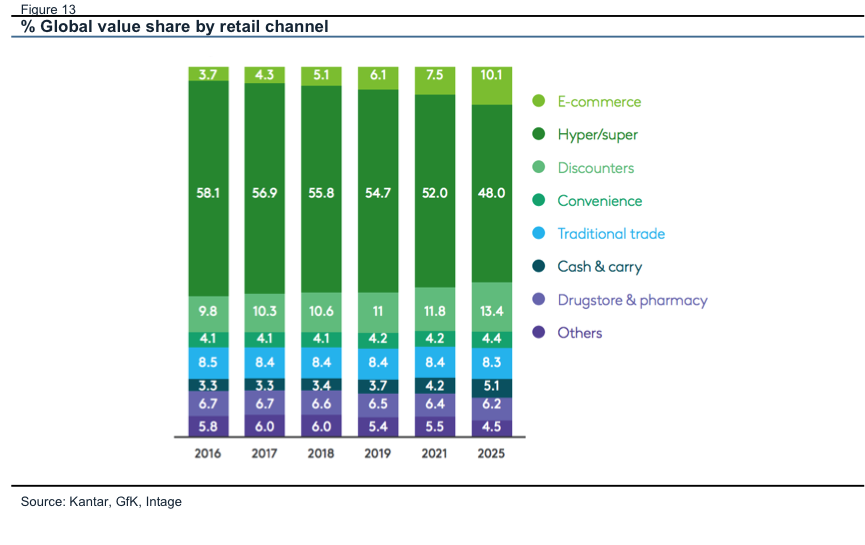
Contrary to some belief, retail isn’t dead or dying, it really is evolving. Yes, store closures have been common place globally, but the future of retail is not as dire as some would have you believe. In fact some retailers are actually opening more stores and winning over market share as others struggle to evolve. The reality is that retail is still flourishing but per above this is at the online shopping and also the small format stores. There is no denying it, we live in a culture of convenience. “Kids these days” want things now and they want things the way they want it. This is driving small store formats to grow faster than larger formats such as hypermarkets where having sharp and targeted product offerings in easily accessible locations such as in petrol kiosks, train stations and other footfall catchment areas, will continue to endure and steal market share away from traditional cafes, eateries and hypermarkets.
 |  |
Anticipating and acting on shifting consumer needs are more crucial than ever as retailers adapt to survive the New Retail Economy. To properly enable companies to serve their customers better through understanding their needs, the CEO of our consumer investee company bluntly puts it, “we are a tech company”. And for all intents and purposes, he is right, that there is a need for consumer companies today to understand their customers’ need and wants particularly in areas such as product demand, communication, costs, offers, loyalty and returns. Satisfying this expectations for tailor made offerings, convenience and instant gratification, could be done through obtaining information from past purchases to target marketing efforts which directly lead to better sales. A platform that automates information-gathering and decision-informing processes also means that businesses save time for more creative pursuits, using reporting and forecasts to build more accurate orders their customers will love. With technology that provides real-time data and analytics, and improves communication across the community, retailers are better equipped to adapt operations to understand and take advantage of shifting consumer preferences. It is though not without challenge as targeted marketing requires the collection of personal information which can be hard to come by given the lack of trust in giving out this data. This is confirmed by a study in 2019 by Microsoft where only 31% of respondents in APAC trust organisations offering digital services to protect their data.
The ‘one size fits most’ style of doing business is today a thing of the past and will have to evolve to ensure customers have a tailor made offering specific to their needs. From an investor stand point, there is not only a need to understand sectorial, demographic, logistics and cost structures, there is also a need to understand systems and how companies are positioning to serve their customers better. We are no longer at that ‘build and they will come’ phase in history. Today, options are endless and consumers are not as loyal as before. If you are not catering to your customers’ innate needs and wants, someone else will.
Author Certification:
All views presented above strictly reflect our personal views at the time of publishing. It should in no way be viewed as intending to dictate, advise in investment decisions or to solicit for business.
Important Disclaimers:
This document is produced and distributed by Karrin Associates Pte. Ltd. It has sole ownership over its materials and information provided in this document is strictly confidential. Any confidentiality breaches should assume any and all liabilities.
Information provided in this document is not audited and should not constitute investment advice or a recommendation. The recipient agrees that this document shall be used solely as references and not for any other purpose, commercial or otherwise. Any investment decision must be made solely on the basis of the recipient’s own due diligence. Karrin Associates and its subsidiaries, affiliates, controlling persons, directors, officers or employees do not accept any liabilities whatsoever for any decision taken based upon the material.