

The Asian Consumer : A Rising Tide (Part 1 of 2)
Amidst the vast swathe of hard hit sectors from the Covid-19 pandemic, the Asian consumer segment in our view stands out as having both good cyclical and structural prospects, which we at Karrin Associates are focused on. While we are positive on its medium to long term prospects, that is not to say that the Covid-19 virus have not impacted it severely, it has and would probably hit it again if a second wave is observed. That said having risen from extreme poverty and with technology, demographics and industry on its tailwinds, the Asian consumer segment sticks out as a candidate which will likely compound over the coming decades. After all, 3 in 5 people in this world are Asian.
This is Part 1 of 2 editions investigating the merits of the Asian consumption story.
From the ‘world’s factory’ to consumption powerhouse
In the start of the modern era, powerful empires of Asia were economically and territorially dominant. Asia far outstripped Europe on indicators of development as international trade activity between the Mediterranean and China along the Silk Roads as well as the South East Asian spice trade, yielded great returns for Asian empires. Alas, European success from the 15th century Age of Discovery in search of territories and supplies along with progress brought through the Industrial Revolution in the 16th Century, changed the course of history, shaping European dominance for centuries. While this holds true till today, through the availability of resources and the merits of comparative advantage, much of Asia is seeing higher growth as it undergoes its own industrial revolution, supplying the world with materials both finished and unfinished.

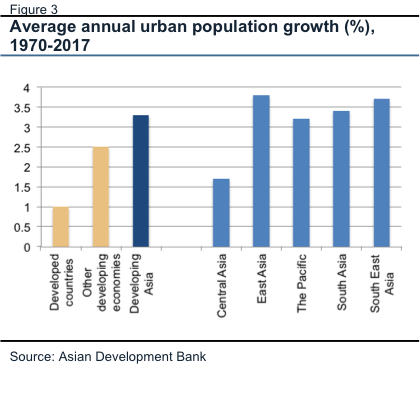
The wealth impact from the industrialisation of Asia has been immense especially when considering the speed of which these improvements have taken place. The World Bank notes that over the past 3 decades, nearly 1.1 billion people globally have moved out of the poverty line, and a majority of this is in Asia. The numbers are staggering- in the last 2 decades alone, the improvements in extreme poverty in China and India has resulted in the 42% figure dropping to 12% in India and a spectacular 0.7% in China in 2017. This over 270 mil of people moving out of extreme poverty coincided with the increase of 5x in urbanisation since 1970 (the fastest region in absolute and growth rates), with 2/3 of the near 1.5 bil additional urban folks coming from India and China. This rapid improvement to standard of living is indeed remarkable, largely fuelled by income opportunities, directly or indirectly from the industrialisation of Asia
 |  |
Basic necessities like access to water, electricity, food, shelter and clothing are today widely available across Asia. This has resulted in better standard of living metrics such as life expectancy, literacy and availability of healthcare, among others. With higher income from better job opportunities, the Asian consumer is today moving up the hierarchy of needs, demanding more improvements to its lifestyle and self-development. Education is one of those areas we witness a surge in demand – in 2010, a mere 25% of high school students in China end up enrolled in college, a figure which is today at 40%. Aggregate demand for a whole host of consumer items across the board have seen a paradigm shifted upwards, such as protein consumption, shampoos, cars, computers and many others.
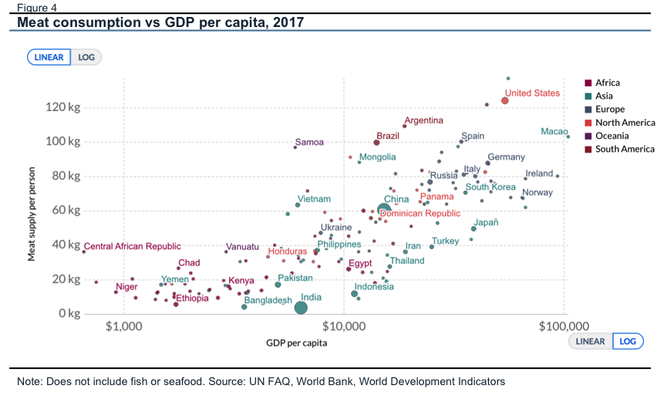
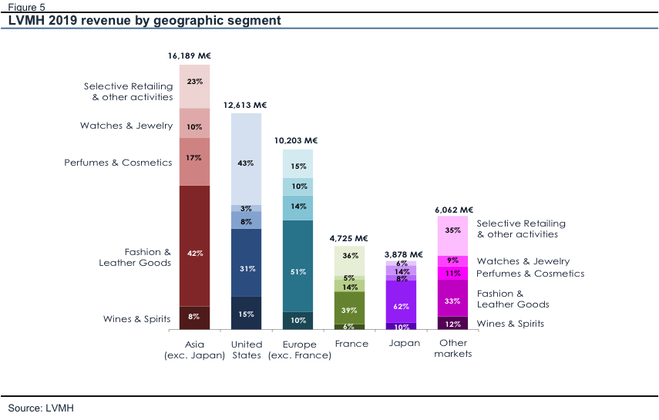
Further up the income chain, the Asian luxury goods market is equally hot and pursued by large global brands none better exemplified than the 30% (EUR16.2bil) of its 2019 global revenues that luxury retailer LVMH generated from Asia (37% if including Japan), higher than any other region. The vast improvement in living standards will likely only accelerate further if the study by Homi Kharas and Geoffrey Gertz titled The new global middle class: A cross-over from West to East, were to hold true – that the middle-class population in Asia-Pacific could make up nearly 66% of total global middle-class population by 2030, up from a mere 28% in 2009. This rising income level coupled with a growing young population (ex Japan) would likely fuel the rise of purchasing power and ambition over the next few decades bringing about a boon for both the consumer staple and discretionary segments.
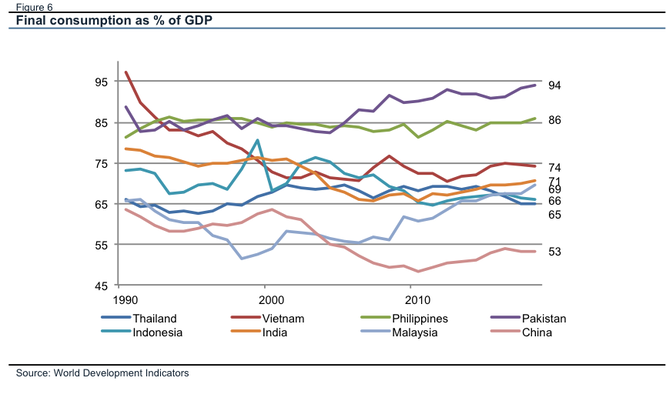
While it is disappointing that the export growth model which it has been built on in the past few decades is reaching saturation with the Americans and Europeans spewing out protectionism policies particularly at China, the Asian road to prosperity will unlikely be derailed given the availability of its own large market place and the fact that shifting global supply chains require immense effort, time and money. Nevertheless, if the scenario should hold true, the intra Asia trade for final consumption as well as domestic consumption will be key in ensuring quality of life continues to improve in Asia. The good news is with increased income experienced by much of developing Asia over the last few decades, Asian consumers have decidedly spent more on themselves, resulting in the domestic consumption as a percentage of total GDP rising noticeable across most countries in developing Asia (except Thailand) over the last decade. The creation of this insular demand, essentially enables Asia to be less dependent on exports, allowing it to flourish through the growth of its own marketplace.
Technology, demographics and the move towards middle class
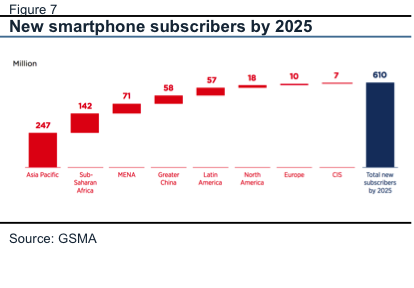
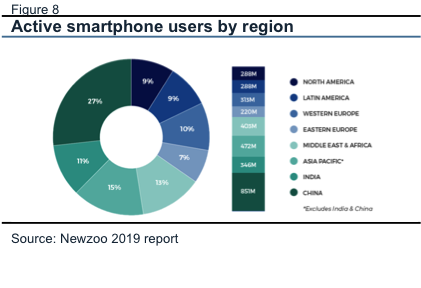
Further driving Asia’s already rapid acceleration in consumption, is the availability of technology. The access to the digital economy provided by smart phones is far reaching hence reducing the need for extensive and expensive offline presence. This has resulted in consumers today leapfrogging the regular stages of development seen historically in the developed world. For example, while the number of its population owning bank accounts in Indonesia or Philippines still lags per capita numbers in other developing countries, perhaps this time rather than having a bank account, such consumers would instead utilise digital currencies and e-wallets to consume products and services in the already available digital market place. Such a change in consumers jumping the natural progression of what is regular in the past has only been made possible by technology. Understanding this has vital investment consequences especially when it is estimated that by 2025, there will be 600 mil more new smart phone users with half from Asia, this adding to the already large 1.7 bil users currently in Asia.
 |  |
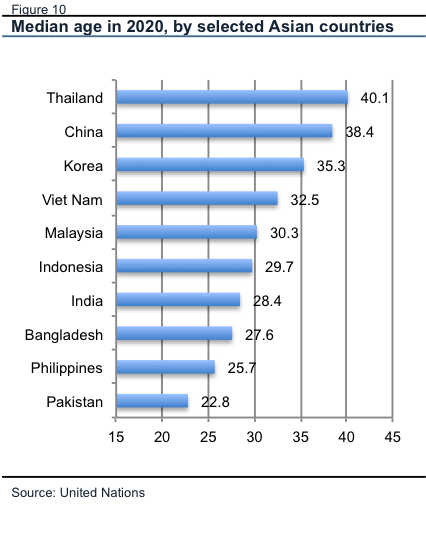
Asia’s future is in actual fact its present. With a median age of 32 in Asia (30.2 in ASEAN), its population is largely relatively young particularly when compared to its peers in the developed world. They are of prime working age, fully adapted to technological changes and have many years ahead to create wealth. While China’s median age of 38 is relatively higher given the one child policy, it is worth nothing that over 400mil millennials currently live in China, this providing some idea of just how large market opportunities are in the Asian consumption space.
 |  |
Potential is vast but there is a need for understanding
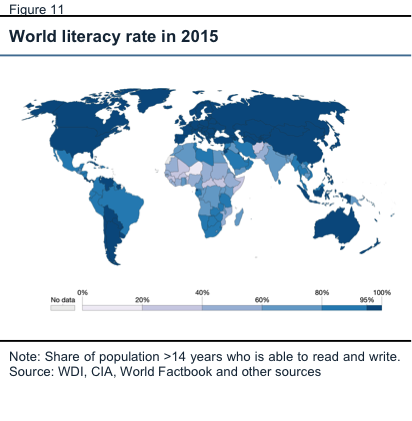
While there has been immense progress in living standards across Asia over the last few decades, the grass is not all green. For now, in many countries such as India, Indonesia, Philippines and others, many necessities are still considered luxury. Literacy rates while having seen vast improvements are lagging particularly in South Asia and South East Asia. Urbanisation too still lagged at 46% in 2017, compared to the average in developed economies at 81% and other developing economies at 58%. To put things in context, developing Asia’s current urbanisation rate is comparable to the US over 100 years ago and Japan in early 1950s. Many parts of Asia are still underdeveloped and none more so than India where urbanisation sits at a mere 34%.
 |  |
Some of these deficiencies capture just how wide the range of fortunes is within Asia. On one hand we speak of the boom in Louis Vuitton purchases and on another the inability to purchase a television or read a book. Humanitarian aspects aside, the opportunity of meeting these needs in Asia are indeed vast, particularly as countries such as Indonesia and India with smartphone penetration of 43% and 24% respectively, are in early phases of smartphone growth which in turn provides extraordinary market potential across all categories of goods and services. The key in unlocking the potential is in understanding consumer nuances, cultural proclivity, domestic limitations and other quirks and inclinations. We discuss these further in Part 2 of The Asian Consumer.
Author Certification:
All views presented above strictly reflect our personal views at the time of publishing. It should in no way be viewed as intending to dictate, advise in investment decisions or to solicit for business.
Important Disclaimers:
This document is produced and distributed by Karrin Associates Pte. Ltd. It has sole ownership over its materials and information provided in this document is strictly confidential. Any confidentiality breaches should assume any and all liabilities.
Information provided in this document is not audited and should not constitute investment advice or a recommendation. The recipient agrees that this document shall be used solely as references and not for any other purpose, commercial or otherwise. Any investment decision must be made solely on the basis of the recipient’s own due diligence. Karrin Associates and its subsidiaries, affiliates, controlling persons, directors, officers or employees do not accept any liabilities whatsoever for any decision taken based upon the material.