

Vietnam – Phoenix From The Ashes
Like a phoenix rising from the ashes, Vietnam’s strong recovery from a turbulent start to the decade, is almost expected. For as fluid as it is resilient, the gleaming skyline of Ho Chi Minh makes it easy to forget that it has only been 50 years since the end of the catastrophic Vietnam War in 1975. Vietnam has since transitioned from a war-ravaged, agricultural economy to a vibrant centre of manufacturing, trade and soon, technology. This will to succeed and the strong wind in its sails, drive what is the story of Vietnam today – a country with attractive population demographics, globally connected to the world’s supply chain and now with the political willingness to be in the drivers seat of delivering strong economic growth.
Politics in Vietnam matters. This is true for Vietnam and also much of South East Asia, if not the world. For over the last 5 years which saw the height of the past General Secretary Nguyen Phu Trong’s high profile anti- corruption campaign, government related pump priming were absent with businesses equally wary of investments given the uncertainties. Government officials of all ranks were targeted where since 2016, over 139,000 party members have been disciplined. Notably, eight Politburo members, including former presidents and other high ranking members, were equally not spared, being removed from their positions forcefully. To put this into perspective, between 1986 and 2016, no Politburo members were ousted for corruption and only nine members of the Central Committee were disciplined for corruption-related offences.
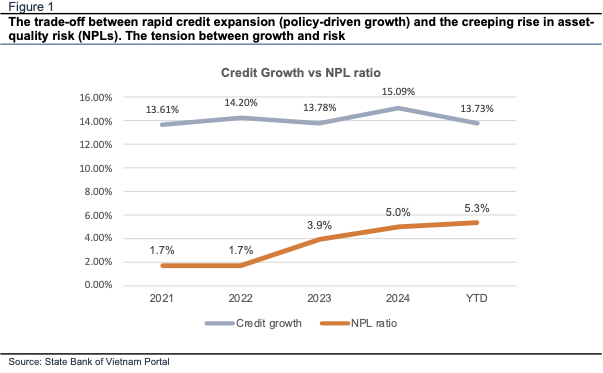
With the passing of Trong in mid 2024 and the ascension of the new General Secretary in To Lam, there is a sense of excitement in the business community, where the leadership stance has since transformed into that of growth with particular focus in public sector pump priming (28-30% YoY growth YTD) and the banks following suit with a sustained 14% credit growth. The macros have been positive whereby GDP growth of close to 8% is expected this year, with the current account remaining steady at 5% of GDP with reserves at USD80 bil, 2 month cover for an export oriented economy. While the China + 1 story has been thrown a curveball with the US tariff impositions, the FDI flows predominantly to the manufacturing sector continues where the first 9 months of the year saw USD28.5 billion in FDI, up 15.2% year-on-year.
Walking the streets of Ho Chi Minh, it is anecdotally evident that there is a buzz about the place. Streets are full with young Vietnamese and cosmopolitan faces, restaurants are busy on weekdays, properties, ring roads and factories are being built. Infrastructure spending is in full swing with Railway Roads, Energy and Technology, the key area of focus supported by low interest rates at levels not seen in decades. As fiscal deficits and government leverage are proving to be limiting factors, there is a keen interest to push for Public/Private partnerships by the government. While this presents interesting opportunities to various companies, the ability of the private sector to fund these projects also remains to be seen, as most if not all banks are running CET1 ratios at single digits and a system Loan to Deposit Ratios already >100% and not forgetting the dreaded system NPL which has been creeping up to 5.3% from 5% last year.
One way the government is looking to address the liquidity issue is to fully focus on regulatory reforms and new policies with the intent of attracting businesses and foreign investments. For years, the key limiting factor preventing foreign investors from investing into Vietnam has been the Foreign Ownership Limits (FOL) in various industries where limits as high as 100% to as low as 5-10% in some instance. Through the recently implemented Decree 245, which amends aspects of Decree 155/2020/ND-CP, companies can today no longer unilaterally decide on their own maximum foreign ownership levels, with government agencies being told to potentially revise ownership limits in areas that do not impact national security. The recent inclusion into the FTSE Emerging market index by Sept 2026 will help, though more tangible progress needs to take place to fully unlock these liquidity impediments which should ultimately avail Vietnamese businesses to new pots of capital.
The stock market is at 15x forward PE (20x current) which is not cheap for Vietnam and this has been predominantly driven by the Vin group of companies which make up a significant part of the index- VIC, VHM, VRE all up 2-3X YTD. The FTSE inclusion (USD1bil expected inflow) on October 7 which upgraded Vietnam from frontier to secondary emerging, effective from September 21, 2026 (contingent on review in march 2026), were well expected by the market with some arguing that an MSCI would be required to really move the needle.
There is little doubt that Vietnam has all the makings of a great multi-year fundamental story. That said, given the run up, investors are needing more concrete evidence of sustained earnings growth at this juncture before deciding on the next leg. Interestingly, foreigners have net-sold another US$1b of VN equities in Sep, lifting their net-selling YTD to over US$4b. The recent negative newsflow on the banks misuse of proceeds from corporate bond issuances are some cautionary signals that the road to fulfilling its massive growth potential will not always be rosy, something which makes it part of the Vietnamese experience. We like the story and we think there is every reason for Vietnam to deliver in its growth. That said, some patience will be required along the way.

Author Certification:
All views presented above strictly reflect our personal views at the time of publishing. It should in no way be viewed as intending to dictate, advise in investment decisions or to solicit for business.
Important Disclaimers:
This document is produced and distributed by Karrin Associates Pte. Ltd. It has sole ownership over its materials and information provided in this document is strictly confidential. Any confidentiality breaches should assume any and all liabilities.
Information provided in this document is not audited and should not constitute investment advice or a recommendation. The recipient agrees that this document shall be used solely as references and not for any other purpose, commercial or otherwise. Any investment decision must be made solely on the basis of the recipient’s own due diligence. Karrin Associates and its subsidiaries, affiliates, controlling persons, directors, officers or employees do not accept any liabilities whatsoever for any decision taken based upon the material.