

The Hangover
Resistance approaching just when implementations get tricky.
The proverbial alphabet soup of stimulus introduced by the Fed and the American government has fuelled a >30% relief rally above March 23rd lows, sufficient to sway bears into thinking that market lows have been reached. This relief has been greeted with some fanfare, but a slew of downgrades by banks, IMF, OPEC and abysmal data points observed last week, are stark reminders that the hangover post the cash binge can easily diminish complacency into despair. Taking a closer look at what drives the S&P500 index exhibits a c.22% reliance on 5 key tech stocks namely Microsoft, Apple, Amazon, Facebook and Alphabet, all of whom are within range of reclaiming all time highs. Market breadth implies a weaker undertone, with only 15% and 22% of stocks reclaiming its 200 DMA and 50 DMAs. Sectors like banks, industrials and real estate show a more realistic print.
 |  |
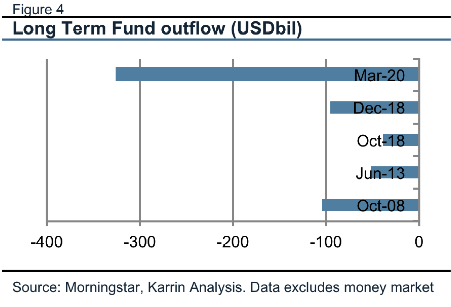
Explaining the March 2020 sell down is the USD326.3bil which investors pulled from US Long term funds in March 2020, a whopping 3x that in Oct 2008 (1.7% of total assets; 2008 c.1.5% of total assets). What was not quite expected was a total net inflow of USD10.5bil back into US Equities in March 2020, where the corresponding USD31bil outflow from active management was met with a sizeable inflow of USD41bil into passive funds, this explaining the buying of late, which seems to be indifferent towards economic/earnings data.
 |  |
While there has been positive news on the virus front, a peaking of the virus count does not equate to there being no new infections. There is still a need to exercise care but the catch 22 is such that (exhibited by the deterioration in China and Singapore) a reopening of the economy before thorough containment and a reliable number of test availabilities, risks high likelihood of reinfections and further closures, but equally, further closure beyond June 2020 jeopardies further economic destruction at the SME end which may be difficult to come back from. These are tough decisions to make and under those circumstances, it is safe to say that until a drug is found (Gilead best case: 500,000 remdesivir available in Oct20 and 500,000 by end 2020) the reopening of economies will have to be tentative and at best partial.
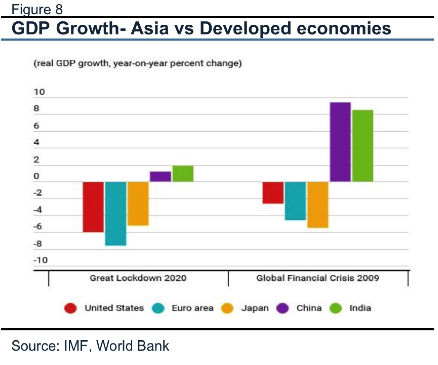
It is worth reiterating that it is rational to remain structurally bearish on asset prices especially as the 3 key indicators of aggregate demand being GDP (IMF downgrades global growth in 2020 to -3%: US-6%, Europe -6.6%, China +1.2%), oil (WTI at 18 year low and falling) and bank earnings (widely deteriorated with credit costs expected to continue escalating) all suggest a prolonged period of pain. There is also an immediate need to recognise that the continued deterioration in US and global unemployment figures (US currently 18% but likely over 20%), the tedious implementation/surveillance of fiscal support and the escalating feud between US and China, all serve as reality checks, which will likely irritate. While that is rational, a market sell down will require triggers. The areas we are watching closely are deteriorating property prices, a slower rollout of fiscal stimulus, currencies, escalating debt levels of corporates, individuals and countries and credit defaults.
Politically, other thorny issues which will likely stall any progress to hasten bailouts will be the moral hazard debate surrounding debt forgiveness/subsidies and along with that the merits of affluent individuals (hedge funds, businesses of political leaders and celebrities) equally applying for subsidies. These grouses will likely escalate into political hot-potatoes, forcing battle lines to be drawn once again as bipartisan spirit is put away to tackle the impending Presidential election. It is now that the performance of the Trump administration in handing the virus will be heavily scrutinised.
This week, a few key data points to watch out for are US home sales (Tuesday) an initial jobless claims (Thursday), along with earnings today (Monday) for IBM, Infosys, and China Mobile followed by Coca Cola, Netflicks and Texas Instruments on Tuesday. As we sit 4.4% away from the mental resistance of 3,000 in the S&P500 (200DMA of 3014 is 4.8% away), and given stretched 2021 PE ratio of 18.3x (long term average of 15.2x), the direction that the market takes is not necessarily cast in a straight path. Though having come off the peak of 82.69, CBOE Volatility Index (VIX) is still at 38.15, 10.2% above its 50DMA indicating that investors are very concerned about a decline in the stock market. It would therefore not be inconceivable that the common ‘Sell in May and go away’ maxim often touted in a tongue-in-cheek manner by investors, could just hold true this time around and statistically (or fundamentally), this would not be without reason evidenced by Figure 6 exhibiting clear under performance of the S&P500 over the 4 months of June-September over the last 30 years. Only this time, no one is really going anywhere for summer.
 |  |
Collective failures of institutions. Expect economical, political and social changes. US-China fallout.
In its far-reaching path of destruction, the spread of the Covid-19 virus has inadvertently uncovered the fragilities of human lives, economically, politically and socially. Centre to this has been the collective failures of institutions entrusted by society, none more glaring than the inability of governments to do the basic form of governance that is to protect its citizens and the continued deficiencies of corporates/central banks in exercising equitable financial discipline despite painful lessons from the past. All these misconducts risk being swept under the “Covid-19 carpet” when in truth, deep distrust of misaligned politicians and corporates saddling companies with debts while paying huge salaries, dividends and manipulating value through stock buybacks, have been on-going for a while now. For the first time in a very long time, the tide has turned, and those who have been swimming naked are there for all to see. Like the tide, the virus is only the trigger, not the cause.
The world today is witnessing an unprecedented transfer of wealth from the poor to the rich exhibited by the strong performance of the stock market against a backdrop of flagging employment, deflation and a pile of debt for the future generations to deal with. It is this ‘kicking of the can down to road’ of not punishing mismanagement that has led society again towards this cross road where it is forced to decide if they are okay with corporate bailouts or should these companies be left to fall? Realistically, there is no broad brush to paint with giving varying situations across companies. That said, it is also remarkably unfortunate that in a time when the independence and jurisprudence of the Fed is needed on this matter, its choice to bail out weak companies, venture capitalists and private equity firms in the riskiest of fashion, completely goes against the principle of laissez-faire, a travesty of epic proportions to say the least.
In understanding the dire implications of these mistakes, one must enter the minds of the millennials. Defined as being born in 1981 to 1996, millennials make up c.25 pct and 35% of the world and working population respectively. Having a deep preference for an equal society where individuals are judged by their merits and not race, these technologically and academically equipped global citizens value transparency, empowerment and seek greater causes. They are flexible, choosing not to own fixed assets (or debts) and marrying later in life, meaning that borders, hierarchy and religion are unlikely to hinder or influence in a great fashion. When considering these characteristics, it becomes clear that not only are corporate/institutional misbehaviours frowned upon, but also that the ideologies of nationalism, boisterous bullying tactics and political lip service espoused by loudmouth rage mongering politicians like Donald Trump and Boris Johnson, do not necessarily resonate. This is seen in a Pew research survey, which found a mere 1 in 5 Americans trusting the federal government to do the right thing. If in the past having the wealth to acquire boats, weapons and an army meant world domination, in a flatter world like today, being a functional, reform seeking and reliable government while providing growth opportunities through science, technology and finance, take the cake. The world is changing and what is needed from governments is also evolving. For starters, public healthcare the world over clearly needs attention.
While the West has its fair challenge in finding its path, the East, for all the plaudits of having widespread pragmatism, capable governments (how quickly did that hospital come up) and ample infrastructure (many exception) which were widely exhibited by the handling of the virus, still has some way to go in attracting the talent pool of the western world or at least in eliminating the exodus of its citizens seeking the “American dream”. Chief to this is the urgent need for China (and the East) to be responsible and trustworthy global citizen. This includes being sincere with its undertakings either as governments or corporates -dare we even suggest an opening of its capital account. Incidentally China’s 329 mil population of millennials alone are bigger than the population of the US as a whole (9 out of 10 millennials live in emerging countries). If IMF forecasts are true, then Asia is looking pretty with its orthodox monetary policy and sustained activity coming out of the Covid-19. Interestingly, this window for the East comes conveniently at a point when the US is weakening.
 |  |
Assuming the US to go down without a fight would be exceptionally unfounded. In fact an all out economic attack against China could be the next ‘Black Swan’ to contemplate, especially if evidence of foul play in China’s alleged cover up of the Covid-19 virus is to be found, demonstrating that China had not acted in good faith when entering pandemic force majeure clauses into the trade agreement signed with the Trump administration earlier this year. We expect this deterioration of US-China relationship to play out over the course of the next 6 months as the Trump administration could gain popularity through ‘sticking it to China’, that is if Donald Trump is not seen to have been outfoxed by President Xi.
At the very least, the base case assumption for investors should be a realignment of the US supply chain (and any countries exporting products to the US) away from China. In our books the ones to benefit as early as 2021 are countries with available infrastructure, supply chain network and expertise/labour at a competitive cost. These are likely in ASEAN and South Asia with Africa, Eastern Europe and Latin America likely to prosper over the medium term. Along with the realignment of the supply chain, investors should expect changes in consumer habits where hygiene, product reliability and affordability taking centre stage. The continued switch towards digital services will also resonate where e-commerce, online experience, self-entertainment and development, are themes to watch out for. Investment habits will continue to evolve but should see a renewed emphasis towards quality, environmentally conscientious companies and honest and capable management, across asset classes.
Invest in what you understand – Oil ETFs in focus.
Expanding on the subject matter of oil from last week’s edition titled (Un)clear and Present Danger where we remained sceptical of Opec+’s ability to manage the balance of oil supply with faltering demand, there has been increasing interest in investing in an oil rebound, given the contango situation where futures prices are higher than spot prices indicating a possible uptrend in spot prices. This has invited increasing speculative positions through the commodity ETF markets where futures exposures in the US Oil Fund ETF (USO) appear particularly popular, the USO alone making up a whopping 28% of June 2020 WTI NYMEX contracts and still seeing >USD1bil inflows last week alone. Just simply astounding.
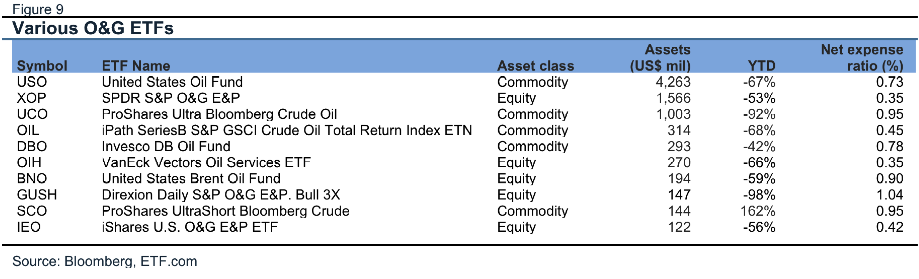
We agree that bets on oil appear to have decent long term risk reward given its severe underperformance and the thesis that oil demand should slowly improve. That said, while contangos are good for physical oil traders who are theoretically able to buy physical positions in the spot, hedge price risks through futures contracts, hold the oil at storage facilities and then sell it a few months later (assuming demand) for a spread, in the case of ETFs with futures contracts, investors must be aware that this is the absolute opposite. The difference arises from the mathematical construction of these instruments where time decay and roll over costs of these levered futures positions will ultimately result in severe disappointments given the contango situation. For example as at the close of 17th April 2020, an investor rolling over May into June 2020 NYMEX WTI contracts would theoretically have to shoulder the USD7.02 (39%) cost difference, resulting in a severe drag to any kind of returns.
 |  |
We continue to see good opportunities in the space but equally many ‘value’ traps to avoid. Guided by the words of Warrant Buffett of not investing in something you don’t understand, we opine that the best investment methodology for most is investing in companies through thorough understanding of balance sheets, cashflow generation and vitally the ability and alignment of interests of management in surviving low prices. This space evolves, daily.
10 Lessons from isolation.
Sitting in lockdown for over a month, it is only human to contemplate on life, finding what is important and looking at ways to improve. While these could just be another failed new years resolution and we could very well go back to doing things just the same way we have always been doing, that said, at the risk of saying ‘this time it is different’ only because this time it has indeed been different, these are ten lessons the author has learned from isolation:
1. Life is fragile – enjoy it, do what you love, exercise, be hygenic and spend time with your closest and dearest.
2. You can do anything you put your mind to – men can cook and do grocery runs!
3. Mass media is full of nonsense – do your own research, understand risks, invest in people you trust.
4. You don’t need much material in life – food, water, shelter, electricity and WiFi.
5. You can work efficiently from home – the need for office space could be impacted.
6. Religion did not save anyone– doctors and nurses did. Appreciate the good in religion, but ask questions.
7. Humans are strongest when working in unison – discriminations and separatist agendas limit potential.
8. Governments matter– vote very wisely.
9. There are so many unsung heroes in our lives – be generous, be empathetic, be part of society.
10. Financial buffers are important – invest smartly, save diligently.
Author Certification:
All views presented above strictly reflect our personal views at the time of publishing. It should in no way be viewed as intending to dictate, advise in investment decisions or to solicit for business.
Important Disclaimers:
This document is produced and distributed by Karrin Associates Pte. Ltd. It has sole ownership over its materials and information provided in this document is strictly confidential. Any confidentiality breaches should assume any and all liabilities.
Information provided in this document is not audited and should not constitute investment advice or a recommendation. The recipient agrees that this document shall be used solely as references and not for any other purpose, commercial or otherwise. Any investment decision must be made solely on the basis of the recipient’s own due diligence. Karrin Associates and its subsidiaries, affiliates, controlling persons, directors, officers or employees do not accept any liabilities whatsoever for any decision taken based upon the material.