

Global Hegemony
US-China relationship at worst levels
The world today is quickly turning into a two-bloc playground revealing a US-China ‘cold war’ spectacle. Originating with trade disputes following the election of Donald Trump as US President, this US-China spat has since taken on many other forms, lately exacerbated by the Covid-19 virus blame-game and more current is the touchy subject of Hong Kong’s sovereignty. With little reason for this spat to abate just yet given the race to the bottom by both US Presidential candidates in finding a common enemy in China, we had identified, in our note titled The Hangover published on 20th April, this deteriorating relationship as a potential Black Swan event to grapple with. As potshots have festered into talks of more serious economic sanctions and legislation threatening the delisting of large Chinese companies from the US stock exchange, we see this relationship potentially taking a turn for the worse. While we are of the opinion that the Western media has had a large part to play in the deteriorating relationship between the two economic giants, let us be clear, this has a lot more to do than just the Covid-19 virus or proxy wars. In fact, it has everything to do with global hegemony.
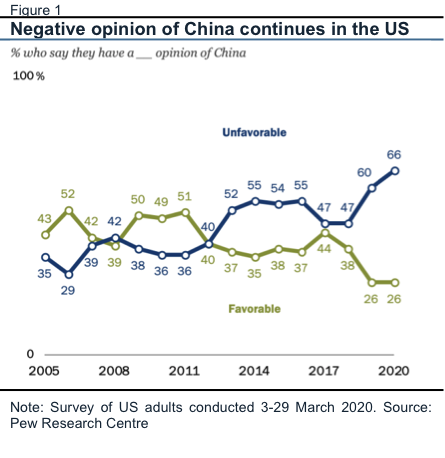 | 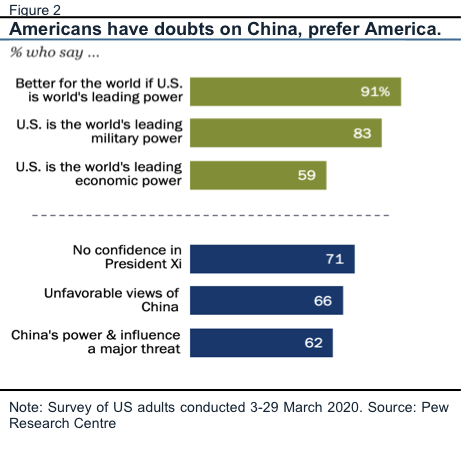 |
After being a dominant global figure since the World War 2, the US is today finding itself in a pickle – its GDP growth is stalling, interest rates are threatening to go below zero, unemployment at a record high and debts skyrocketing. Despite some colossal figures, all these are somewhat manageable as long as the rest of the world demand the use of the USD, trade with the US and with that, are active participants in its debt programmes. Today, China is threatening this normalcy as the world becomes more exposed to the Chinese economy and less to the US. This surge in prosperity has been met with global (and in particular the US) suspicion where we explore four of such key areas and what China can do to change this perception.
(1) Economic prosperity with inadequate global participation.
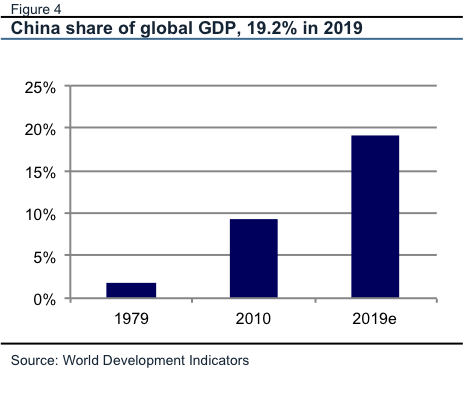
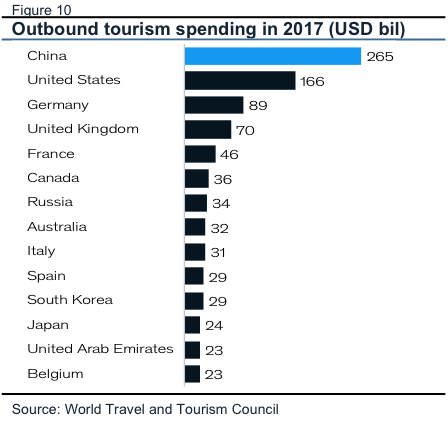
Deng Xiaoping’s economic reform in 1978 post the Mao Zedong Cultural Revolution, introduced a large variation in policy to accommodate capitalism in a socialist setting. This socialist market economy, along with a ‘one country two system’ policy aimed at reunifying neighbouring Macau and Hong Kong, formed the very basis of a widely successful domestic and foreign policy – 40 years ago 88% of China’s population lived on <USD2 a day, that figure today is c.5%. China’s inclusion as a member of the World Trade Organisation in 2001 formally signified its participation in the global arena where since 2014, China has become the world’s largest economy in PPP terms (2019: 19.2% of global GDP), it is the largest trading nation with USD4.6trillion of trade in 2018 (12.4% of global trade vs 11.5% of US) and it makes up a significant 35% of global manufacturing.
 |  |
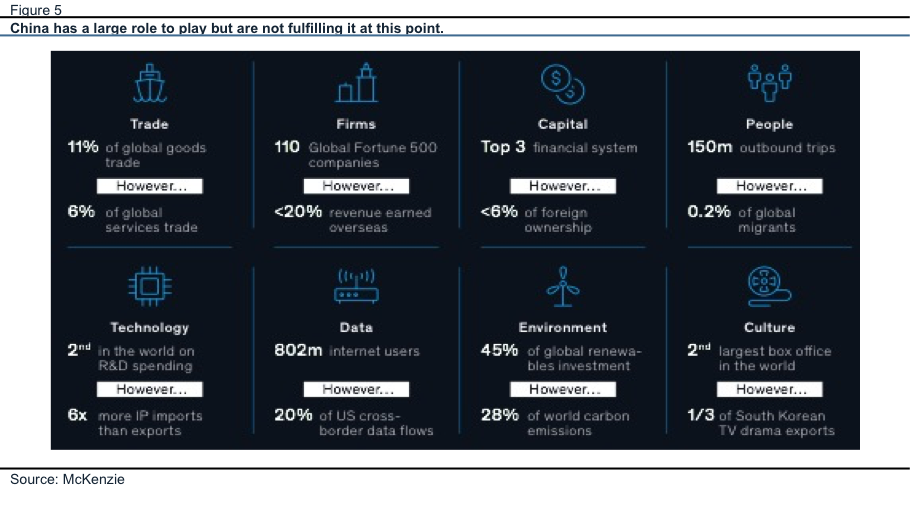
Since its participation in the WTO, the Chinese economy has rapidly evolved from a closed one to a major exporting country where the 4.2% share of exports in China’s GDP in 1978 was met with a 36% figure in 2006. Sustained prosperity from exports led towards a build out of a large consumption-based economy, causing export reliance to fall to 20% GDP with the robust domestic consumption making up c.60% of its GDP. Not many will doubt the economic prowess of China, but many are questioning its ability to integrate responsibly into the global economy and adhering to the spirit of the WTO. Unfortunately, the Chinese economy still remains relatively closed where foreign ownership of bonds, stock markets and the banking system all linger in the single digit range without significant liberalisation for foreign participation. Non-tariff barriers are also in place – its number of internet users is the largest in the world at 800 mil but due to strict firewall measures, cross border data flows (hence e-commerce) are limited at only 20% to that of the US. A majority of its large companies still generate a bulk (c.80%) of its revenues in China and total migrants in China make up a paltry 0.2% of global figures. These are some examples of where China can improve as less engagement with the rest of the world essentially threatens higher tariffs, limiting trade and technology flows.
Originating from the Bretton Woods Accords in 1944, the USD has served as the backing for many foreign currencies, playing an integral part of the world monetary system for more than 70 years. The Chinese Yuan in contrast is merely starting its journey as being a minor reserve currency following the nod by the IMF in 2015 and its subsequent inclusion onto the Special Draw Rights basket in 2016 together with the euro Yen, Pound and USD. This vote of confidence in the Yuan is momentous but worth nothing that despite the world’s heavy dependence on China, the Chinese Yuan currently makes up a mere c.2% of total central bank reserves and <2% of the global payments market. As its outbound capital account remains shut, China’s aspiration of being a global currency will require shrinking its over protectionist policies and to improve international access to its capital markets. Given the sheer volume of trade that it partakes in, should China get its act right, the possibility of replacing the USD as the major reserve currency could quite likely be on the cards.
(2) Differing ideology to that of the developed world.
Despite China’s widely successful economic growth seen over the last 40 years, its incomplete transition into a free market economy has deemed to have brought upon economic policies harmful to US economic interests, such as industrial policies and theft of Intellectual property. In the eyes of the US, China’s continued importation of Intellectual Properties reeks of a classic ‘communist styled’ intellectual property theft, an irresponsible and deceitful act unbecoming of a powerhouse like China. China thoroughly denies these theft allegations and we do not know any better but do believe that the debate of a socialist market economy vs free market capitalism tendencies will endure as long as the differing ideologies of US and China continue to engage in trade and compete for global dominance.

In this respect, China has since 1978 recognised that the right ideology is somewhere in the middle as it saw the need to transform its command economy towards a mixed socialist market economy bringing about widespread reforms through privatisation of state owned enterprises, a comprehensive upgrade in its industries, the undoing of the shadow banking system, a rejig of the supply side and improvements in environmental conditions. These initiatives serve part of a bigger goal for global dominance under the umbrella of the Made in China 2025, Beautiful China 2035 and Belt Road Initiative plans. Amazingly, today we hold in high regard China’s high tech industries, artificial intelligence, biological engineering, and robots, but only as recent as 8 years ago, it would almost be unthinkable to buy a good quality Chinese vessel while today they are known to be one of the world’s best. Such is China’s economic and industrial zeal that we do wonder if such rapid development could have been reached in a purely free market economy, a democracy or a full fledged socialist society.
(3) Geopolitics and the proxy war
The war of influence over the map of the world is a huge determinant in the outcome of this global hegemony struggle. Only unlike the US-Russian edition, this ‘cold war’ with China is not so much a flex of military muscle (yet) but it involves the delicate use of influence, pressure and proxy wars in advancing their own selfish agendas, such as the securing of important minerals, strategic geopolitical routes, new export markets and ultimately the use of its currency. If the American’s excuse of ‘defending democracy’ is a means of gaining military control over oilfields in the Middle East, China’s method is more a show of its ‘carrot’, that is to fund and build large infrastructure projects for targeted governments who are then beholden to the ‘gratitude’ of China.
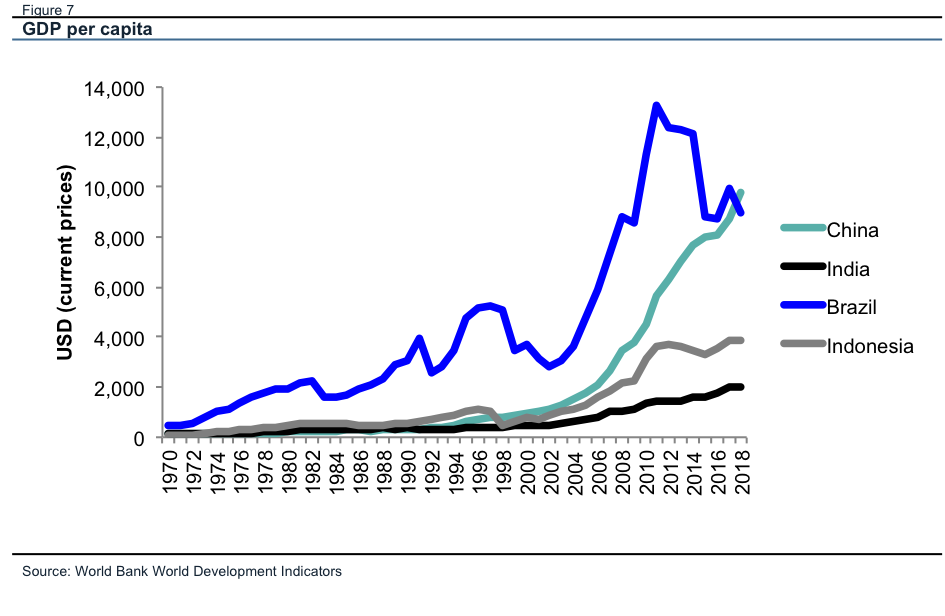
Two strategic regions where China has made good headroom are in some of the fastest growing regions in the world being Africa and ASEAN, which collectively make up 1.7bil in population and natural resources in abundance. Through years of courtship, China is today Africa’s biggest trading partner (USD204bil in 2018), a provider of a third of China’s oil, 20% of cotton and other important material such as manganese, cobalt, carbonatites etc. China in return is the funder and builder of most large infrastructure projects in Africa and for that, 20% (2018) of all African government debts are owed to China where in from 2000-2017, a sum of USD143 bil in loans were provided by China to Africa some of which have been written off ‘in kind”.
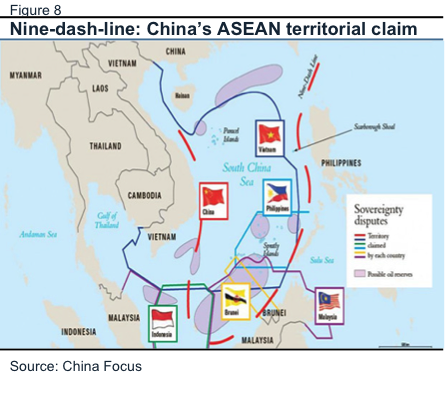 | 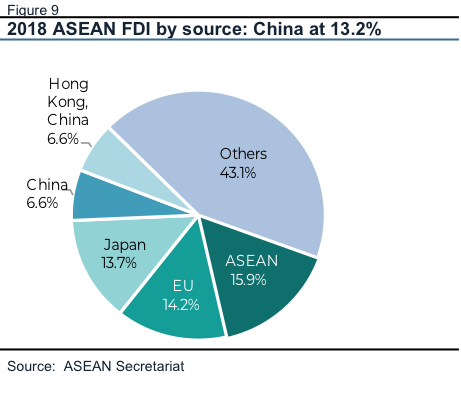 |
The story in ASEAN is not yet as drastic but appears to be moving in that direction as the latest 2020 survey amongst ASEAN country members saw 7/10 in favour of China over the US. Galvanising this popularity is the Belt Road Initiative, where in 2017 saw a pledge from China to invest more than $1 trillion in building a network of ports, roads, railways and other logistics-related projects stretching through Southeast Asia, South Asia and beyond. The Chinese have made progress in particular in Indonesia, where it has funded, build and own (40%) the Jakarta-Bandung high speed rail project and in other countries like Malaysia, Philippines and Thailand similar infrastructure projects which essentially promotes the use of China’s raw materials, credit, man power and in the process extending influence over these countries. While the access to infrastructure here appear to be the ‘carrot’, the stick could surely come in the form of the ‘nine-dash-line’ claim (China’s overlapping territorial claim from Brunei, Malaysia, the Philippines, Taiwan and Vietnam which the UN ruled against in 2016) over the South China Sea where China’s increased military presence has caused strained diplomatic ties unsurprisingly with these ASEAN countries whom have also yielded to the Chinese carrot. Ultimately, the ASEAN chapter is a key acid test in examining China’s sincerity in its Belt Road Initiative, failing which a proxy war in this previously US controlled region will likely tick up another notch.
 |  |
(4) Chequered Human Rights track record
China’s human civil rights track record has been appalling to say the least. According to Amnesty International, the Chinese human rights situation is marked by a systematic crackdown on dissent, a justice system plagued by unfair trials and torture and with continued tightening on Christians’ and Muslims’ freedom of religion and belief. Furthermore, LGBTI people saw unrelenting discrimination at home, at work, in schools and in public, while all media from print to online games and the Internet saw widespread surveillance and censorship. Looking at events, the Tiananmen massacre, though in the past, serves as a poignant reminder of China’s historical disregard for human rights, scary especially when compared with the on-going involuntary detention of Uighur Muslims.
The handling of the Hong Kong protests arising from revelation last week that China’s National People’s Congress (NPC) will bypass Hong Kong’s legislature to impose anti-sedition laws which could undermine civil liberties in the semi-autonomous city, will be closely watched by the international community. Hong Kong, having garnered support from Taiwan, the US and Australia to name a few, will likely plead for support from the international community as it would be seen powerless to stop these sweeping changes destined to “help combat the force of ‘Hong Kong independence’ and restore social order.” As of now, President Trump appears uninterested in these developments but should the US take action by disregarding Hong Kong’s Special Administrative Region status, subjecting it to similar tariffs and visa restrictions to that of China, the widespread fall out from this proxy war seeing as China would likely not tolerate any impingements on its sovereignty, could just be the straw that break the camel’s back
In conclusion
At this point it seems a foregone conclusion that China will play a more permanent role in global leadership. It has the financial means, the support (willing or unwillingly) of a large portion of global population, access to food and natural resources and most importantly the wisdom of not being snookered into making uncalculated political and economical blunders. Whether or not the rest of the world takes this favourably will depend on China’s ability to provide evidence of it shedding its chequered past for a more responsible and trustworthy persona, this potentially starting with it treatment of Hong Kong. Should these hold true, the Chinese Yuan for one has immense potential of playing a bigger role in global trade particularly if its investments in Africa, ASEAN and South Asia show higher political traction, and other financial initiatives such as the digitalising of the Yuan and the expanded usage in the Petroyuan for facilitating China’s oil importations from its partners, are proven to be successful. For now, China must shore up confidence in the Yuan and avoid the temptation of excessively depreciating its currency even if trade issues start creeping up.
In the case of the US, it remains our view that it is in its best interest to cooperate and coexist with China given the vast influence both have over trade, the global financial system and security. However, as political rhetorics appear to have chosen a nationalistic slant, it remains to be seen if the US will readily coexist with China as ‘joint leaders’ or will it continue its fervour in firing political juggernauts at China. At this point, it appears as though the lows in the US-China relationship could probably worsen and we do wonder how much of this animosity towards China is indeed China’s doing or if it is in actual fact due to the fading solitary global supremacy that the US has enjoyed since World War 2.
Author Certification:
All views presented above strictly reflect our personal views at the time of publishing. It should in no way be viewed as intending to dictate, advise in investment decisions or to solicit for business.
Important Disclaimers:
This document is produced and distributed by Karrin Associates Pte. Ltd. It has sole ownership over its materials and information provided in this document is strictly confidential. Any confidentiality breaches should assume any and all liabilities.
Information provided in this document is not audited and should not constitute investment advice or a recommendation. The recipient agrees that this document shall be used solely as references and not for any other purpose, commercial or otherwise. Any investment decision must be made solely on the basis of the recipient’s own due diligence. Karrin Associates and its subsidiaries, affiliates, controlling persons, directors, officers or employees do not accept any liabilities whatsoever for any decision taken based upon the material.